Top Ethics and Compliance Software: Comparison Guide for 2026
Explore leading ethics and compliance software, learn how these platforms strengthen compliance programs, and what to consider when choosing the right solution for your organization.


Ethics and compliance leaders face a difficult balancing act. They must encourage employees to speak up, investigate concerns quickly, protect reporters from retaliation, satisfy regulators, and demonstrate program effectiveness to executives and boards.
At the same time, many organizations still rely on disconnected hotlines, spreadsheets, email inboxes, and manual reporting processes, which make it difficult to manage investigations consistently or to identify emerging risks.
Modern ethics and compliance software helps organizations centralize reporting, automate investigations, strengthen oversight, and gain visibility into the health of their compliance programs. But not all platforms are built the same.
In this guide, we’ll compare the leading ethics and compliance software solutions, key features, common use cases, and the factors buyers should evaluate before making a decision.
What is ethics and compliance software?
Ethics and compliance software helps organizations manage employee reporting, misconduct investigations, regulatory obligations, and program oversight through a centralized platform.
At its core, the software provides employees, contractors, vendors, and other stakeholders with a safe way to report concerns. It also gives compliance teams the tools they need to investigate allegations, document findings, and demonstrate accountability.
Common capabilities include:
- Anonymous reporting channels
- Whistleblower hotline management
- Case management and investigations
- Conflict of interest disclosures
- Anti-retaliation monitoring
- Audit-ready recordkeeping
- Analytics and dashboards
- Program assessments and benchmarking
Traditional whistleblower systems primarily focus on collecting reports. Modern ethics reporting and compliance platforms go much further by helping organizations understand why allegations occur, identify recurring patterns, and continuously improve compliance culture.
For ethics and compliance leaders, the goal is bigger than managing cases. Now, it’s about creating a system that delivers actionable intelligence about organizational risk, speak-up culture, and program effectiveness.
Who uses ethics and compliance management software?
Ethics and compliance software supports a wide range of stakeholders. In practice, these teams rarely work in isolation. A single case can move across compliance, legal, HR, audit, and security, which is why a shared system matters more as programs mature
Chief ethics and compliance officers
CECOs and Chief Compliance Officers are ultimately accountable to the board, the audit committee, and regulators for whether the program works. Their challenge is proving effectiveness with evidence rather than assurances and spotting cultural or conduct risk before it becomes an enforcement action or a headline. They use these platforms to:
- Demonstrate program effectiveness
- Support board reporting
- Monitor organizational culture
- Track regulatory readiness
- Spot reporting trends early
Compliance program managers
Program managers run the day-to-day engine of the compliance function. They make sure no report slips through the cracks, cases are handled consistently, and the right people are looped in at the right time. Tasks and touchpoints include:
- Case intake across multiple channels
- Triage, severity scoring and routing
- Investigation workflows
- Reporting and analytics for leadership
- Policy enforcement and enforcement
Legal teams
Legal gets pulled into high-risk and sensitive matters, where the stakes are regulatory exposure, litigation, or privilege. Their priority is defensibility: a clean record, controlled access, and documentation that holds up if a case is scrutinized later. Legal often participates in investigations involving:
- Fraud
- Corruption
- Insider trading
- Harassment
- Regulatory violations
Human resources leaders
HR teams frequently partner with compliance teams on workplace conduct, where confidentiality and fair, consistent handling matter as much as the outcome itself. They handle matters such as:
- Harassment
- Discrimination
- Retaliation
- Code of conduct violations
Internal audit and risk teams
Audit and risk leaders treat aggregated case and reporting data as an early warning system. They use ethics and compliance platforms to:
- Identify trends across cases, regions, and units
- Evaluate control effectiveness
- Flag emerging risks
- Connect individual cases to broader risk
What features should buyers compare when choose ethics and compliance software?
Ethics and compliance software has evolved over the past decade from a simple reporting tool into a strategic solution. When comparing platforms, look past the feature checklist and ask what each capability actually does for your program. For example:
- Anonymous and multi-channel reporting through web, phone, mobile, and other channels, with multilingual intake and secure two-way communication that encourages employees to report concerns while protecting their identity when requested.
- Investigation management with streamlined workflows for triage, assignment, tasks, evidence, and deadlines, so cases are handled consistently rather than ad hoc.
- Reporting Analytics and dashboards that push visibility beyond case counts into trends, cycle times, and outcomes across regions and business units.
- AI capabilities that build efficiency across intake, triage, and investigations, with human review behind each output rather than unchecked automation.
- Configurability to scale and adapt to new case types, jurisdictions, and approval flows without heavy IT effort.
- Integrations that connect with HR, identity, and case systems so data is not re-keyed and context is not lost as cases move between teams.
-
Workflow automation that automatically routes reports, triggers notifications, enforces SLAs, and reduces manual administrative effort.
- Case governance and defensibility with standardized investigation playbooks, complete audit histories, evidence management, and documentation controls that help organizations conduct fair, consistent, and auditable investigations.
- Security and access controls with role-based access, encryption, and confidentiality protections appropriate for the most sensitive investigations you handle.
- Program Assessment and Benchmarking as boards and regulators increasingly expect evidence that a program is effective and working, not just a tally of reports received.
Organizations should weigh the capabilities that improve long-term effectiveness. It also pays to think ahead: teams that buy only for today’s volume often outgrow a basic tool within a year or two, then pay again to migrate data and retrain staff.
Top ethics and compliance software compared
No single platform is right for every organization. The best solution depends on investigation complexity, regulatory obligations, organizational size, and reporting requirements.
The following comparison examines where each platform excels and where buyers should look more closely.
1. Resolver
Best for: Enterprise ethics and compliance teams seeking investigative depth, program insights, and measurable effectiveness in a single platform.
Resolver is a purpose-built ethics and compliance platform for organizations that treat security as a source of intelligence, not just a system of record. Where most tools stop at capturing reports and closing cases, Resolver connects reporting, investigations, analytics, and benchmarking so leaders can see patterns, understand culture, and prove to boards and regulators that the program is working.
The software includes deep investigation workflows, AI-assisted operations with human oversight, ECI-powered benchmarking, executive- and board-ready reporting, connected intelligence across people, assets, and cases, and configurable workflows that scale with growing ethics and compliance programs.
Key features: AI-guided intake, automated triage and case routing, automated investigative playbooks, AI-generated case summaries, anonymous two-way communication, program assessments, ECI-powered benchmarking, executive dashboards, conflict-of-interest workflows, anti-retaliation monitoring, link analysis, pattern detection across investigations, and multi-jurisdiction compliance support.
Limitations: Advanced capabilities may exceed the needs of smaller organizations with low volumes of investigations.
Pricing: Resolver offers custom pricing based on organizational size, deployment requirements, and program complexity. Contact vendor for pricing.
2. NAVEX
Best for: Organizations seeking a long-established compliance suite.
NAVEX remains one of the most recognized names in ethics and compliance technology. The platform combines hotline services, policy management, training, and case management capabilities within a broad compliance ecosystem.
Key features: Hotline services, policy management, compliance training, incident reporting, and case management.
Limitations: Investigation workflows feel clunky, implementation and administration can be highly complex to manage, and analytics lack the depth needed to identify recurring risk patterns and program performance.
Pricing: Pricing depends on the organizational size and program complexity. Contact vendor for pricing.
3. Case IQ
Best for: Organizations focused primarily on investigations and case management.
Case IQ is known for its investigation-centric approach and structured case management capabilities. Organizations managing a significant volume of workplace investigations often consider the platform because of its focus on investigation workflows and case tracking.
Key features: Investigation workflows, case tracking, AI, incident management, evidence management, and reporting tools.
Limitations: The AI is not as effective as advertised; the platform has fewer native integrations, and places less emphasis on benchmarking, program assessments and cross program insights, thereby lacking broader compliance intelligence.
Pricing: Pricing depends on the program needs of the organizations. Contact vendor for pricing.
4. EQS Integrity Line
Best for: European organizations focused on whistleblower compliance.
EQS Integrity Line supports confidential reporting and helps organizations manage whistleblower obligations across multiple jurisdictions, particularly within Europe.
Key features: Anonymous reporting, whistleblower intake, multilingual reporting, support for the EU Whistleblower Directive, and case management.
Limitations: The platform relies on rigid, inflexible case management workflows that are difficult to adapt to complex organizational structures. Furthermore, its basic reporting and trend analytics cannot deliver the enterprise-wide pattern detection and peer benchmarking found in broader compliance suites.
Pricing: EQS Integrity Line offers tiered subscription pricing. Contact vendor for pricing.
5. SpeakUp
Best for: Organizations prioritizing employee reporting and speak-up culture.
SpeakUp focuses on helping organizations create accessible reporting channels that encourage employees to raise concerns safely and confidentially.
Key features: Anonymous reporting, employee reporting channels, two-way communication, case intake, and support for the speak-up program.
Limitations: The platform lacks robust, end-to-end investigation management tools to support a case to resolution. It also lacks the strategic compliance intelligence, predictive trend analytics, and peer benchmarking required by mature, enterprise compliance teams.
Pricing: Depends on the organization size, requirements, and program customizations. Contact vendor for pricing.
6. Ethico
Best for: Organizations seeking hotline services and employee ethics support.
Ethico provides hotline and ethics reporting services for organizations looking to strengthen employee reporting channels and support programs.
Limitations: Built primarily as a transactional hotline and intake solution, this platform lacks comprehensive lifecycle tools and analytics for managing complex, multi-stage investigations to guide strategic program decisions.
Pricing: Ethico provides custom pricing based on organizational needs and deployment requirements. Contact vendor for pricing.
7. GAN Integrity
Best for: Organizations looking to manage ethics and compliance alongside third-party risk.
GAN Integrity is a cloud-based ethics and compliance platform focused on helping organizations manage compliance programs, third-party risk, conflicts of interest, policy management, and whistleblowing within a single platform.
Key features: Third-party risk management, policy management, disclosures and conflicts of interest, whistleblowing, case management, and compliance program reporting.
Limitations: Investigation capabilities are less mature than dedicated ethics platforms, third-party questionnaire workflows can create friction for external users, and implementation can be complex for new administrators.
Pricing: Pricing depends on the requirements customizations. Contact vendor for pricing.
Ethics and compliance software comparison summary
For ethics and compliance leaders evaluating multiple vendors, the table below summarizes each platform’s ideal fit, strengths, and potential limitations.
|
Platform |
Best for |
Strengths |
Limitations |
|
Resolver |
Enterprise organizations seeking investigation depth, program intelligence, and measurable compliance outcomes |
AI-guided intake, automated triage, investigative playbooks, AI case summarization, ECI-powered benchmarking, program assessments, pattern detection, link analysis, configurable workflows, and board-ready dashboards |
May provide more advanced capabilities than smaller organizations require |
|
NAVEX |
Organizations seeking an established hotline and compliance suite |
Well-known brand, hotline services, policy management, training modules, and broad market adoption |
Investigation workflows are less comprehensive; benchmarking relies heavily on survey-based data; limited program intelligence capabilities compared to purpose-built investigation platforms |
|
Case IQ |
Organizations focused primarily on investigations and case management |
Strong investigation workflows, case tracking, and reporting capabilities |
Limited benchmarking and program effectiveness measurement; less emphasis on culture, retaliation monitoring, and strategic compliance insights |
|
EQS Integrity Line |
European organizations focused on whistleblower compliance obligations |
EU Whistleblower Directive support, multilingual reporting channels, and hotline capabilities |
Investigation management is less robust; limited analytics and benchmarking; less suited for complex enterprise investigations |
|
SpeakUp |
Organizations prioritizing employee reporting and speak-up culture initiatives |
User-friendly reporting experience, anonymous communication, and employee engagement focus |
Limited investigation depth; fewer advanced workflow capabilities; less strategic reporting and analytics functionality |
|
Ethico |
Organizations seeking hotline services and employee ethics support |
Hotline services, employee support resources, and case intake capabilities |
More focused on intake than full investigation lifecycle management; limited advanced analytics, benchmarking, and program intelligence capabilities |
|
GAN Integrity |
Organizations looking to manage ethics and compliance alongside third-party risk |
Broad coverage across ethics, policy, disclosure, reporting, and third-party risk workflows within one system |
May be less suitable for teams that need highly advanced investigation workflows; setup and external questionnaire processes can require additional effort |
Common ethics and compliance use cases
Ethics and compliance software supports a wide range of reporting, investigation, and program oversight needs. For enterprise organizations, the value is not only in managing individual cases. It is in understanding how those cases connect to broader cultural, operational, and regulatory risks.
Whistleblower reporting and investigations
Ethics reporting and compliance software helps organizations capture reports through multiple channels, support anonymous communication, route cases to the right investigators, maintain audit-ready records, and track investigations through resolution.
Workplace misconduct and harassment
Workplace misconduct investigations often involve HR, legal, compliance, and business leaders. Ethics and compliance software helps teams manage these cases consistently while protecting confidentiality.
Common examples include:
- Harassment
- Discrimination
- Bullying
- Policy violations
- Inappropriate conduct
Structured workflows help investigators document interviews, manage evidence, and apply consistent standards across cases.
Conflict of interest disclosures
Conflicts of interest can be difficult to manage when disclosures are collected through email, forms, or spreadsheets. Ethics and compliance software centralizes disclosure intake, review, approval, and follow-up activities while creating a clear record of decisions and mitigation actions.
This helps organizations improve transparency, reduce administrative effort, and demonstrate compliance with internal policies and regulatory expectations.
Insider threat reporting
Insider threat concerns often sit at the intersection of compliance, HR, legal, and security. A connected platform can help teams identify links between people, assets, cases, locations, and previous reports.
This matters because individual cases may appear isolated until teams can see related patterns.
Fraud, bribery, and corruption investigations
Fraud and corruption investigations require careful documentation, escalation, and oversight. Ethics and compliance software helps organizations manage allegations of fraud, bribery, accounting irregularities, vendor misconduct, gifts and entertainment, and FCPA-related violations.
By centralizing evidence, workflows, and reporting, organizations can conduct more consistent investigations and maintain defensible records throughout the process.
Code of conduct violations
Code of conduct concerns can range from minor policy issues to serious misconduct. A centralized platform helps organizations classify cases consistently, assign owners, and identify recurring patterns across departments, locations, or business units.
Retaliation monitoring
Reporter protection is essential to a healthy speak-up culture. Ethics and compliance software helps organizations track retaliation concerns, monitor related case activity, document protection measures, and identify emerging trends that may undermine employee trust.
This visibility helps compliance leaders strengthen reporting culture and reinforce confidence in the organization’s ethics program.
When should a business invest in ethics and compliance software?
Many organizations start with basic reporting channels, shared inboxes, or spreadsheets. That may work for a small team with limited case volume. But as the organization grows, manual processes create risk.
Organizations typically outgrow manual processes when cases are tracked in spreadsheets, reporting requires manual data collection, multiple teams operate in separate systems, regulatory complexity increases, or leaders lack visibility into reporting trends and program effectiveness.
Organizations that are scaling an ethics and compliance program need systems that support consistent intake, defensible investigations, and meaningful reporting as case volume and complexity increase.
How ethics and compliance software strengthen compliance programs
The right platform does more than help teams close cases. It strengthens the operating model behind the compliance program.
Improves reporting culture
Employees are more likely to report concerns when reporting channels are clear, confidential, and accessible. Anonymous reporting, multilingual intake, and two-way communication help reduce friction and build trust.
Speeds up investigations
Automated triage, routing, task management, and investigation playbooks help teams move faster without losing consistency.
AI case summarization can also reduce the time investigators spend turning notes, evidence, and activity history into review-ready summaries.
Enhances regulatory readiness
Many organizations must manage obligations under SOX, FCPA, the EU Whistleblower Directive, the UK Bribery Act, and other frameworks.
Ethics and compliance software helps teams maintain structured records, consistent workflows, and audit trails that support regulatory readiness.
Provides program effectiveness evidence
Regulators, boards, and audit committees increasingly expect compliance leaders to show that their programs are not just documented, but effective.
Benchmarking, as well as ethics and compliance assessments, help organizations measure reporting trends, case outcomes, retaliation concerns, investigation efficiency, and overall program maturity.
Delivers strategic program intelligence
The kind of insights modern ethics and compliance leaders need go beyond a list of closed cases. They need to understand what the data is telling them.
That includes questions like:
- Are allegations increasing in a specific region?
- Are the same people or business units connected to multiple cases?
- Are retaliation concerns rising?
- Are investigations taking too long?
- Are employees using reporting channels consistently?
- Are cultural issues emerging before they become larger risks?
These can improve culture, reduce allegations, and strengthen organizational accountability.
Choosing the right ethics and compliance management software
The best ethics and compliance platform depends on your organization’s maturity, size, risk profile, and regulatory environment. Before choosing a vendor, look beyond surface-level features and consider how the software will support your team over time.
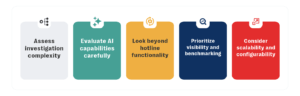
Assess investigation complexity
Start by asking:
- How many cases does the organization manage each year?
- Which teams participate in investigations?
- How often do cases involve legal, HR, internal audit, or security?
- Do investigations require evidence management or chain-of-custody tracking?
- Are cases spread across multiple countries or jurisdictions?
If your investigations are complex, a basic hotline or case tracker may not be enough.
Evaluate AI capabilities carefully
AI can help compliance teams work faster, but it should support human judgment — not replace it.
Useful AI capabilities include:
- Guided intake
- Automated classification
- Severity scoring
- Case summarization
- Pattern detection
- Related-case clustering
- Executive summary generation
Buyers should also ask how AI outputs are reviewed, explained, and audited.
Look beyond hotline functionality
Hotline intake matters, but it is only one part of the compliance lifecycle. A strong ethics and compliance platform should help teams move from first report to investigation, resolution, reporting, benchmarking, and program improvement.
Prioritize visibility and benchmarking
Without strong analytics, compliance leaders are left with anecdotes. Dashboards, benchmarks, and program assessments help leaders explain what is happening, why it matters, and where the organization should focus next.
Consider scalability and configurability
As programs mature, workflows change. Look for software that can adapt to new case types, jurisdictions, approval processes, reporting needs, and organizational structures without requiring heavy IT support.
Why organizations choose Resolver for ethics and compliance
Resolver helps ethics and compliance teams connect reporting, investigations, benchmarking, and program intelligence into a single configurable platform.
Instead of treating each case as a standalone issue, Resolver helps leaders understand how cases relate to people, assets, business units, locations, and broader program trends.
Organizations use Resolver to centralize reporting, automate triage, standardize investigations, generate AI-assisted summaries, manage conflicts of interest, monitor retaliation risks, identify patterns across investigations, benchmark program performance, and deliver board-ready reporting.
Resolver is built for ethics and compliance teams that need more than intake. It supports the full lifecycle from first disclosure to investigation closeout, program assessment, and executive reporting.
As organizations mature their ethics and compliance programs, Resolver scales with them. Global organizations like Jabil use Resolver to:
- Strengthen speak-up culture
- Streamline investigations
- Replace manual reporting with actionable dashboards
- Integrate HR and business systems
- Turn investigation data into insights that drive accountability and continuous improvement across the enterprise.
Resolver’s configurable workflows and no-code platform also allow teams to adapt processes as regulatory requirements and organizational needs evolve without relying on costly custom development.
That makes Resolver especially useful for organizations that want to improve reporting culture, speed investigations, reduce administrative burden, and show measurable progress to leadership.
Frequently asked questions
What is ethics and compliance software?
Ethics and compliance software helps organizations capture reports, manage investigations, track disclosures, monitor retaliation risks, and measure the performance of compliance programs through a centralized platform.
What are the most important features to compare in ethics and compliance software?
The most important features include anonymous reporting, multi-channel intake, automated triage, investigation workflows, AI case summarization, dashboards, benchmarking, program assessments, audit trails, and multi-jurisdiction compliance support.
How does ethics and compliance software support investigations?
It supports investigations by centralizing case information, routing reports to the right teams, assigning tasks, documenting evidence, tracking deadlines, generating summaries, and preserving a complete audit trail.
What is the difference between whistleblower software and ethics and compliance software?
Whistleblower software typically focuses on reporting channels and intake. Ethics and compliance software is broader. It supports intake, investigations, conflict-of-interest monitoring, analytics, benchmarking, and program improvement.
How do AI features improve ethics and compliance programs?
AI can help improve report quality, classify cases, summarize investigations, identify related cases, and reduce administrative work. The strongest platforms keep compliance professionals in control through reviewable, auditable AI outputs.
Can ethics and compliance software support global regulatory requirements?
Yes. Many platforms support multi-jurisdiction requirements, including the EU Whistleblower Directive, SOX, FCPA, UK Bribery Act, and other regulatory expectations. Buyers should confirm that the platform supports the regions and obligations applicable to their organization.
How do ethics and compliance platforms help prevent retaliation?
They help teams track retaliation allegations, document reporter protection steps, monitor related employment actions, and identify retaliation trends across the program.
How do I choose the right ethics and compliance platform?
Choose a platform based on your investigation complexity, reporting needs, regulatory obligations, program maturity, analytics requirements, and long-term scalability. Avoid choosing based only on hotline functionality.
How much does ethics and compliance software cost?
Most enterprise ethics and compliance software vendors provide custom pricing based on organization size, scope, capabilities, and implementation needs. Contact vendors directly for pricing.
What industries benefit most from ethics and compliance software?
Industries with complex regulatory obligations and distributed workforces benefit most, including financial services, healthcare, manufacturing, energy, government, education, technology, and professional services.
See Resolver’s ethics and compliance management platform in action
Ethics and compliance leaders need more than a hotline or case tracking system. They need visibility into program effectiveness, investigation outcomes, reporting culture, retaliation risks, and emerging patterns across the organization.
Resolver helps organizations move beyond reactive case management with AI-assisted workflows, embedded benchmarking, investigative intelligence, and board-ready reporting that demonstrate the value of their compliance programs.
Explore Resolver’s Ethics and Compliance software to learn how it can strengthen investigations, improve oversight, and support a more effective compliance program.