Best AI Compliance Software: Compare AI Capabilities and Find the Right Platform for 2026
Compare leading AI-powered compliance software and see how AI in compliance can streamline workflows, reduce manual work, and strengthen the program.

AI has quickly become a standard part of modern compliance. In Resolver’s survey of 108 GRC professionals, 95 percent said they already use AI in their everyday workflows. The question is no longer whether AI belongs in compliance; it’s how organizations can use it to improve efficiency, strengthen decision-making, and stay ahead of an increasingly complex regulatory landscape.
As organizations continue to use AI in compliance workflows, they’re finding that the greatest value comes from supporting, not replacing, compliance professionals. By automating repetitive tasks, surfacing relevant insights, and helping teams prioritize their work, AI gives compliance leaders more time to focus on managing risk and improving regulatory readiness.
This guide explores what AI compliance software is, how it’s changing compliance management, and the key capabilities to look for when evaluating today’s leading platforms.
What is AI compliance software?
AI compliance software uses artificial intelligence to help compliance teams manage regulatory content, workflows, and tasks more efficiently. This includes activities such as monitoring regulatory obligations, mapping controls, conducting assessments, identifying compliance gaps, and preparing reports. While the term can sometimes refer to tools for governing an organization’s own AI systems, this guide focuses on AI-powered compliance management software that helps organizations strengthen and streamline their compliance programs.
How AI compliance software differs from traditional compliance software
Traditional compliance platforms focus primarily on organizing information and supporting workflow execution.
AI compliance software helps organizations extract more value from the data already stored within those systems.
For example, a compliance team managing SOC 2, ISO 27001, PCI DSS, NIST CSF, and regional regulations may need to review hundreds of overlapping requirements.
- Without AI, teams often perform this analysis manually.
- With AI, organizations can more quickly identify similarities between requirements, recommend related controls, and highlight areas that may require additional review.
As regulatory expectations continue to evolve, organizations are also exploring how AI can support regulatory interpretation and monitoring.
Also Read: Top Compliance Management Software in 2026
Discover Resolver's solutions.
Why purpose-built AI compliance software matters now
Artificial intelligence is already part of many compliance professionals’ daily workflows. But there’s an important difference between using a general-purpose AI assistant and using AI that’s embedded within a compliance management platform.
General AI tools can help summarize documents or draft content, but they lack the organizational context, governance, and auditability required for enterprise compliance. AI built directly into a compliance platform works with your regulatory obligations, controls, assessments, and compliance data, helping teams make better decisions without sacrificing oversight.
Compliance decisions require organizational context
General-purpose AI tools don’t understand your organization’s compliance program. They aren’t connected to your control library, regulatory obligations, previous assessments, or internal policies.
AI embedded within a compliance platform can use this organizational context to deliver more relevant insights, reduce duplicate work, and support more consistent decision-making across compliance activities.
Enterprise compliance requires governance and traceability
Compliance teams need confidence in how decisions are made and documented. Recommendations generated by AI should be transparent, reviewable, and supported by an audit trail.
Purpose-built AI compliance software helps organizations maintain appropriate governance by keeping AI-assisted activities within existing compliance workflows, where actions, approvals, and decisions remain traceable.
AI should improve existing workflows, not create new ones
Many teams already use AI to summarize regulations or draft documentation. Switching between standalone AI tools and compliance systems, however, creates disconnected workflows and increases the risk of inconsistent information.
AI that’s integrated directly into compliance software allows teams to review regulatory changes, identify potential gaps, generate reports, and support assessments without leaving the platform where they already manage their compliance program.
Top AI compliance software reviewed for 2026
As AI becomes a standard feature in compliance platforms, the real differentiator is how effectively it’s applied to compliance work. Not all AI capabilities are created equal. Some platforms simply add generative AI features, while others embed AI directly into regulatory analysis, control mapping, assessments, reporting, and other compliance workflows.
The following solutions are among the leading AI-powered compliance platforms. As you compare them, consider factors such as contextual awareness, workflow integration, governance, traceability, and the practical value their AI capabilities deliver to compliance teams.
1. Resolver
Best for: Organizations seeking AI-powered compliance management built on connected compliance and risk data.
Resolver embeds AI directly into compliance workflows, giving it the context of your organization’s regulatory requirements, controls, risks, assessments, issues, and remediation activities. Instead of operating as a standalone assistant, AI works within a connected compliance data model to help teams reduce manual effort, improve consistency, and strengthen compliance decision-making.
Key capabilities:
- Analyze similar regulatory requirements to identify overlap and reduce duplicate work
- Map controls to requirements and generate draft controls using AI-assisted recommendations
- Identify potential compliance gaps by analyzing requirements, controls, and assessment data
- Summarize regulatory updates and highlight changes that may impact your organization
- Manage requirements, controls, assessments, issues, and remediation within a connected compliance platform
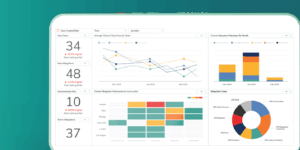
- Monitor compliance performance through dashboards and reporting that provide executive visibility
Pricing: Contact vendor for pricing.
2. Optro
Best for: Organizations focused on internal audit, SOX compliance, and audit-driven risk programs.
Optro, formerly known as AuditBoard, has invested significantly in AI capabilities designed to support audit and compliance activities. The platform is particularly well known for its audit management workflows and documentation support.
Key capabilities:
- Internal audit management
- SOX compliance workflows
- AI-assisted testing support
- Documentation and evidence management
- Risk and controls management
Pricing: Estimated range is $40,000 to $150,000 per year.
3. MetricStream
Best for: Large enterprises operating in highly regulated environments with complex governance, risk, and compliance requirements.
MetricStream is one of the most established enterprise GRC platforms on the market. Its AI-enabled capabilities support compliance, risk management, regulatory monitoring, and policy management workflows across large organizations.
The platform is often considered by organizations that require extensive scalability and support for multiple frameworks, business units, and regulatory environments.
Key capabilities:
- Enterprise-scale compliance management
- AI-enabled compliance analysis
- Policy and controls management
- Broad GRC functionality
Limitations:
- Implementation timelines can be lengthy
- Administrative complexity may require dedicated platform resources
- Organizations with smaller compliance teams may find the platform more extensive than necessary
- Time to value can vary depending on program maturity and configuration requirements
Pricing: Estimated range is $75,000 to $1,000,000 annually.
4. RSA Archer
Best for: Organizations that require extensive customization and highly configurable compliance workflows.
RSA Archer has long been recognized as a powerful governance, risk, and compliance platform. The solution offers deep compliance functionality and flexibility that appeals to organizations with unique regulatory requirements and mature GRC programs.
Recent AI investments have expanded Archer’s ability to support compliance analysis and risk-related decision-making.
Key capabilities:
- Compliance management
- Regulatory tracking
- Risk analysis
- Configurable workflows
- Extensive customization options
Limitations:
- Configuration and administration can require specialized expertise
- Organizations may need dedicated support resources to manage ongoing platform customization
- User experience and implementation complexity may be challenging for teams seeking rapid deployment
- Ongoing maintenance requirements can be significant compared to more streamlined platforms
Pricing: Estimated pricing typically starts at around $55,000 per year and can exceed $200,000 annually.
5. ServiceNow GRC
Best for: Organizations already invested in the ServiceNow ecosystem that want to extend compliance management into broader enterprise workflows.
ServiceNow GRC combines compliance and risk management capabilities with the broader ServiceNow platform. The platform leverages workflow automation and enterprise AI capabilities to support compliance activities across large organizations.
For organizations already using ServiceNow extensively, the platform can provide a centralized environment for compliance-related processes.
Key capabilities:
- Workflow automation
- Enterprise AI ecosystem
- Regulatory compliance support
- Risk management integration
- Broad platform extensibility
Limitations:
- The breadth of the platform can introduce complexity for compliance-focused teams
- Organizations may need to invest in broader platform capabilities than they require for compliance management alone
- Implementation and configuration efforts can be substantial
- Compliance teams seeking a purpose-built compliance platform may find other solutions more focused
Pricing: Estimated pricing is available via custom quotes and generally depends on user tiers, required modules, AI capabilities, platform add-ons, and overall deployment complexity.
AI compliance software comparison table
While every organization has unique requirements, the following table provides a high-level comparison of leading AI compliance software vendors.
|
Vendor |
Best for |
Strengths |
Limitations |
|
Resolver |
Compliance teams seeking connected compliance management and practical AI assistance |
Connected compliance data, AI-assisted control mapping, gap analysis support, and executive visibility. |
Best suited for organizations seeking broader compliance and risk visibility rather than point solutions. |
|
Optro |
Internal audit and SOX programs |
Strong audit workflows, testing support, and a mature audit ecosystem |
Audit capabilities are often stronger than enterprise compliance management. Organizations managing multiple regulatory frameworks may require additional configuration. |
|
MetricStream |
Large, highly regulated enterprises |
Broad GRC functionality, regulatory management, and enterprise scalability |
Implementation timelines and administration requirements can be significant. Some organizations may require dedicated resources to manage the platform effectively. |
|
RSA Archer |
Organizations requiring extensive customization |
Deep compliance functionality, flexibility, and mature GRC capabilities |
Powerful but often resource-intensive. Ongoing administration and customization may require specialized expertise. |
|
ServiceNow GRC |
Organizations already invested in ServiceNow |
Workflow automation, enterprise ecosystem, broad platform capabilities |
The platform’s breadth can introduce complexity for compliance teams seeking a more focused compliance management solution. |
How AI is transforming compliance management
The most significant impact of AI is not simply automation of manual processes. It is helping compliance teams make better use of their time, knowledge, and data.
Accelerating regulatory analysis
Reviewing regulatory updates can be time-consuming.
Compliance professionals often need to:
- Read lengthy regulatory publications
- Identify relevant obligations
- Assess organizational impact
- Communicate changes to stakeholders
AI can help summarize regulatory updates and surface key themes that require further review.
Human expertise remains essential, but AI can significantly reduce the time required to identify and prioritize regulatory changes.
Reducing duplicate compliance work
Many compliance frameworks contain overlapping requirements.
Organizations frequently assess, document, and test similar controls multiple times because the relationships among requirements are difficult to identify manually.
AI can help detect:
- Similar requirements
- Duplicate obligations
- Opportunities for control reuse
This can reduce unnecessary effort while helping organizations maintain stronger consistency across compliance programs.
Improving compliance consistency
Compliance programs often depend on institutional knowledge.
When key personnel leave, organizations can lose valuable context about requirements, controls, and compliance decisions.
AI can support more consistent decision-making by helping teams:
- Standardize control mappings
- Maintain documentation quality
- Apply common evaluation criteria
- Reduce reliance on tribal knowledge
Supporting compliance gap analysis
One of the most promising applications of AI is identifying potential compliance gaps.
AI can assist teams by:
- Reviewing requirement coverage
- Analyzing control relationships
- Highlighting areas that may require attention
Importantly, these recommendations should always remain subject to human review.
Organizations should view AI as a decision-support tool rather than an autonomous compliance engine.
Enhancing reporting and executive visibility
Compliance leaders often spend significant time preparing reports for stakeholders.
AI features in compliance software can help organize information, identify trends, and support reporting activities.
Combined with connected compliance data, this can provide executives with a clearer understanding of:
- Compliance posture
- Regulatory exposure
- Assessment results
- Remediation progress
 |
Top SOX Compliance Software in 2026Evaluate leading SOX compliance software, compare key features, capabilities, and limitations, and learn how to choose the right solution for your compliance program. |
Core capabilities every AI compliance platform should include
Not all AI compliance software is created equal.
Organizations evaluating solutions should look beyond AI marketing claims and focus on practical capabilities that address real compliance challenges.
Essential AI compliance capabilities
Modern AI compliance software should support:
- Regulatory change summarization
- Regulatory research assistance
- Requirement similarity detection
- Requirement-to-control mapping
- Control recommendation support
- Control generation assistance
- Compliance gap analysis
- Workflow automation support
- Impact assessment assistance
The most effective AI capabilities help teams reduce manual effort while maintaining accountability and oversight.
AI governance and trust controls
Organizations should evaluate how vendors approach AI governance.
Key considerations include:
- Human-in-the-loop review
- Explainable outputs
- Audit trails
- Traceability
- Confidence scoring
- Data privacy protections
- Permission-aware access
- Model transparency
Compliance teams should be able to understand how recommendations were generated and maintain full control over final decisions.
A strong compliance management foundation
AI capabilities are only as valuable as the underlying compliance platform.
Organizations should ensure vendors provide:
- Requirements management
- Control management
- Compliance assessments
- Issue management
- Remediation workflows
- Regulatory change management
- Reporting and dashboards
Perhaps most importantly, organizations should evaluate how well compliance data is connected across the platform.
AI performs best when it can understand relationships between requirements, controls, assessments, issues, risks, and remediation activities.
Without that context, AI recommendations may be less accurate, less relevant, and less actionable.
How to choose the right AI compliance software
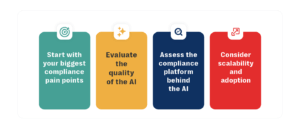
The right AI compliance solution should do more than add AI features to your compliance program. It should help your team manage regulatory obligations more efficiently, improve visibility, and reduce manual work while providing the governance and oversight required for enterprise compliance.
As you evaluate vendors, consider how well each platform addresses your organization’s biggest compliance challenges.
Look for solutions that solve real compliance challenges
Start by identifying where your team spends the most time and effort. Common challenges include:
- Managing regulatory change across multiple frameworks
- Mapping controls to regulatory requirements
- Identifying compliance gaps
- Preparing for audits and assessments
- Creating executive reports
- Maintaining visibility across compliance activities
The right solution should streamline these workflows rather than simply adding AI capabilities.
Evaluate how AI supports compliance workflows
The most effective platforms embed AI into the compliance processes your team already uses. Look for capabilities that help accelerate regulatory analysis, simplify control mapping, identify potential gaps, and improve reporting—all within the same platform.
AI should enhance decision-making while keeping compliance professionals in control of reviews, approvals, and final decisions.
Choose a platform with connected compliance data
AI is only as effective as the information it can access. Platforms that connect regulatory obligations, controls, assessments, issues, and remediation activities provide AI with the context needed to deliver more relevant and reliable recommendations.
A connected data model also improves consistency, reduces duplicate work, and provides better visibility across the compliance program.
Plan for long-term adoption and growth
The best AI compliance solution should support your organization’s needs today while scaling with your compliance program over time. Consider factors such as:
- Ease of implementation
- Configuration flexibility
- Support for multiple compliance frameworks
- Executive reporting and dashboards
- User adoption across compliance teams
A platform that’s easy to adopt and flexible enough to grow with your organization is more likely to deliver lasting value than one that simply offers the largest set of AI features.
Why connected compliance data matters for AI
AI is only as effective as the data it can access.
Many organizations manage compliance information across multiple systems, spreadsheets, and disconnected workflows. As a result, requirements, controls, assessments, issues, and remediation activities often exist in separate silos.
This creates challenges for both compliance teams and AI systems.
Without context, AI may struggle to understand:
- Which controls support which requirements
- How issues impact compliance obligations
- Where remediation efforts are occurring
- Which requirements overlap across frameworks
Connected compliance data provides the foundation AI needs to generate more meaningful insights.
When requirements, controls, risks, assessments, issues, and remediation activities are connected, organizations can:
- Reduce duplicate compliance work
- Improve mapping consistency
- Strengthen compliance gap analysis
- Enhance reporting accuracy
- Increase executive visibility
This is one reason many organizations are moving beyond traditional compliance tracking tools and adopting more integrated compliance platforms.
Resolver’s regulatory compliance software was designed around this connected approach, helping organizations create a more complete picture of compliance performance while enabling practical AI-assisted workflows.
Why organizations choose Resolver for AI-powered compliance management
As compliance programs grow, organizations need more than AI features. They need a platform that helps them manage regulatory obligations, streamline compliance workflows, and maintain visibility across the organization.
Resolver embeds AI directly into a connected compliance management platform, giving compliance teams practical support where they already manage requirements, controls, assessments, issues, and remediation activities.
Rather than relying on generic AI models alone, Resolver’s AI capabilities are designed around real compliance workflows and refined with input from GRC practitioners and customer feedback. This helps ensure AI recommendations are relevant, practical, and aligned with the way compliance teams actually work.
With Resolver, organizations can:
- Analyze similar regulatory requirements to reduce duplicate work
- Accelerate control mapping and draft control creation with AI assistance
- Identify potential compliance gaps using connected compliance data
- Monitor compliance performance through executive dashboards and reporting
- Maintain governance, transparency, and human oversight throughout AI-assisted workflows
By combining connected compliance data with purpose-built AI, Resolver helps organizations reduce manual effort, improve consistency, and build compliance programs that can scale with growing regulatory demands.
Frequently asked questions
What is AI compliance software?
AI compliance software combines traditional compliance management capabilities with artificial intelligence to help organizations analyze requirements, manage controls, identify compliance gaps, support regulatory research, and streamline compliance workflows.
How is AI used in compliance management?
Organizations use AI to support activities such as:
- Regulatory change analysis
- Requirement similarity detection
- Control mapping
- Compliance gap analysis
- Reporting
- Workflow automation
AI helps reduce manual effort while improving consistency and visibility.
Can AI replace compliance professionals?
No. AI is most effective as a decision-support tool. Compliance professionals remain responsible for interpreting regulations, validating recommendations, making decisions, and maintaining accountability for compliance outcomes.
What features should AI compliance software include?
Organizations should look for:
- Regulatory summarization
- Requirement similarity detection
- Control mapping support
- Compliance gap analysis
- Audit trails
- Human-in-the-loop review
- Requirements management
- Control management
- Reporting and dashboards
How do you choose the right AI compliance platform?
The best platform aligns with your organization’s compliance requirements, regulatory complexity, resource constraints, and growth plans. Organizations should evaluate both AI capabilities and the underlying compliance management foundation.
Is AI compliance software suitable for mid-market organizations?
Yes. Many mid-market organizations face increasing compliance demands while operating with lean teams. AI can help improve efficiency, reduce administrative effort, and support program scalability without requiring significant growth in headcount.
What makes Resolver different from other AI compliance solutions?
Resolver’s AI capabilities are built on connected compliance data. By connecting requirements, controls, risks, assessments, issues, and remediation activities, Resolver provides AI with greater context to support more meaningful compliance insights, stronger visibility, and more efficient compliance workflows.
See AI-powered compliance management in action
AI has the potential to transform compliance management, but the greatest value comes when AI is combined with connected compliance data, strong governance practices, and purpose-built compliance workflows.
Organizations that can reduce manual effort, improve visibility, and strengthen compliance decision-making will be better positioned to manage growing regulatory complexity while supporting broader business objectives.
If you’re exploring how AI can help modernize your compliance program, explore Resolver’s Compliance Management Showcase to see how connected compliance management, AI-assisted workflows, and executive reporting work together in a single platform.