7 Top Compliance Management Software Reviewed for 2026
Find the best compliance management software for managing frameworks, controls, obligations, and audits and learn how the right platform can support stronger, more scalable compliance program.


Compliance management is getting harder to scale. Regulatory requirements continue to expand across industries, frameworks, and regions. Teams are expected to manage overlapping compliance obligations across cybersecurity, privacy, financial reporting, and operational resilience programs simultaneously.
Most organizations are trying to manage all of that with disconnected systems. That creates operational blind spots.
That is why modern compliance management software increasingly focuses on connected workflows, integrated visibility, and embedded AI capabilities designed to support, rather than replace, human decision-making.
This guide compares seven of the best compliance management software solutions for 2026, including enterprise platforms, compliance-tracking software, and AI-enabled solutions designed to improve operational resilience and long-term scalability.
Discover Resolver's solutions.
What is compliance management software?
Compliance management solutions help organizations track, manage, monitor, and report on regulatory obligations, internal controls, policies, and compliance activities.
Modern compliance management solutions go far beyond document storage or audit checklists. Today’s platforms help organizations centralize workflows, automate evidence collection, improve reporting, and connect compliance activities with operational risk management.
This is becoming increasingly important as organizations manage overlapping frameworks such as:
Without centralized compliance management systems, teams often rely on spreadsheets, disconnected tools, and manual processes that create inefficiencies and increase risk exposure.
Modern compliance software solutions help organizations:
- Track controls and obligations centrally
- Automate compliance workflows
- Monitor regulatory changes
- Improve audit preparation
- Reduce duplicated compliance work
- Support executive reporting
- Improve cross-functional accountability
The strongest platforms also connect compliance management to broader governance, risk, and operational workflows, helping organizations improve visibility and reduce silos across teams.
Organizations exploring more scalable compliance programs often start by evaluating whether their current systems can support long-term operational growth and evolving regulatory complexity.
7 best compliance management software solutions reviewed
How we evaluated each compliance management software
We evaluated each compliance management software solution based on the factors organizations typically consider when comparing platforms:
- Implementation flexibility: How easily the platform can be configured, deployed, and adapted as requirements change.
- Framework and regulatory support: Ability to manage multiple frameworks, requirements, controls, and overlapping obligations.
- Compliance tracking and monitoring: Support for tracking requirements, controls, evidence, issues, remediation, and compliance status.
- Automation: Capabilities for automating evidence collection, assessments, notifications, control workflows, and remediation.
- Reporting and visibility: Dashboards, audit-ready reporting, executive visibility, and access to compliance data.
- Scalability: Ability to support growing programs, additional business units, jurisdictions, frameworks, and users.
- Operational fit: How well the platform supports broader compliance workflows beyond a single audit or certification use case.
Using these criteria, we reviewed seven leading compliance management software solutions for 2026:
1. Resolver
Best for: Enterprise organizations managing complex regulatory compliance programs across multiple frameworks with connected workflows and embedded AI.
Resolver helps organizations unify compliance management, operational risk, controls, incidents, and remediation workflows within a connected platform designed for scalability and visibility.
Unlike many traditional compliance management systems that operate in silos, Resolver connects requirements, controls, risks, and issues in a single system. This reduces duplication, improves consistency across frameworks, and helps organizations gain a clearer understanding of operational compliance exposure.
Resolver’s no-code flexibility allows compliance teams to adapt workflows, controls, and reporting processes without relying heavily on IT resources.
Its embedded AI capabilities focus on practical workflow support rather than hype-driven automation. AI-assisted workflows can help organizations:
- Summarize regulatory updates
- Map overlapping requirements
- Support control mapping
- Analyze potential control gaps
- Improve consistency across frameworks
Because these workflows operate on connected organizational data, outputs are more contextual, transparent, and operationally useful.
Key strengths:
- Unified compliance management architecture
- Connected controls, risks, and requirements
- Embedded AI for operational workflows
- No-code workflow flexibility
- Strong audit readiness capabilities
- Cross-functional visibility
- Scalable enterprise support
Limitations:
- Teams seeking a lightweight compliance tool may find some capabilities more robust than necessary
- Best suited for organizations seeking integrated compliance maturity
Organizations evaluating scalable compliance management solutions often want to see how connected workflows function in practice. Teams comparing enterprise platforms can explore Resolver’s compliance management software showcases to better understand workflow automation, reporting capabilities, and operational visibility across frameworks.
Pricing: Contact the vendor for pricing.
2. Hyperproof
Best for: Audit readiness and structured evidence collection
Hyperproof focuses heavily on audit preparation, evidence collection, and ongoing compliance monitoring. The platform is commonly used by organizations managing recurring framework certifications and security compliance programs.
Key strengths:
- Strong audit readiness workflows
- Evidence collection automation
- Framework mapping support
- Continuous compliance monitoring
Limitations:
- Less operational risk context than broader integrated GRC platforms
- May require additional systems for enterprise-wide risk visibility
- Limited cross-functional operational workflows
Pricing: Contact the vendor for pricing.
3. Workiva
Best for: Financial reporting and SOX compliance
Workiva is recognized for financial reporting, SOX management, and structured reporting workflows. The platform supports financial controls, regulatory reporting, audit management, and collaborative documentation workflows.
Key strengths:
- Strong reporting capabilities
- Financial governance workflows
- Collaborative reporting tools
- Established enterprise presence
Limitations:
- Less focused on operational compliance management
- May require additional tooling for broader enterprise compliance workflows
- Can become complex for non-financial use cases
Pricing: Contact the vendor for pricing.
4. Optro
Best for: Audit-centric compliance programs
Optro (formerly AuditBoard) remains a strong option for organizations prioritizing internal audit management and controls testing.
Key strengths:
- Internal audit workflows
- SOX and controls management
- Assessment workflows
- Audit reporting
Limitations:
- More audit-led than operationally integrated
- Less emphasis on enterprise-wide compliance visibility
- Limited regulatory change management depth
Pricing: Contact the vendor for pricing.
5. Ncontracts
Best for: Mid-sized financial institutions managing policy and vendor compliance
Ncontracts is commonly used within financial services for policy management, vendor oversight, and compliance workflows.
Key strengths:
- Strong workflow management
- Policy tracking
- Vendor compliance support
- Industry-specific compliance workflows
Limitations:
- Limited data connectivity across broader operational systems
- Less scalable for complex enterprise environments
- May require integrations for deeper operational visibility
Pricing: Contact the vendor for pricing.
6. MetricStream
Best for: Large enterprises requiring highly customized GRC environments
MetricStream offers broad enterprise compliance and risk management capabilities across highly regulated industries.
Key strengths:
- Enterprise scalability
- Deep configurability
- Regulatory tracking
- Broad GRC coverage
Limitations:
- Complex implementation process
- Heavy administrative requirements
- Usability challenges for day-to-day compliance teams
- Longer time to value
Pricing: Contact the vendor for pricing.
7. Archer
Best for: Mature enterprise risk and compliance programs with dedicated IT support
Archer (formerly RSA Archer) has long served large organizations with highly customized governance and compliance requirements.
Key strengths:
- Deep enterprise customization
- Broad risk and compliance capabilities
- Flexible workflow architecture
Limitations:
- Long implementation timelines
- Heavy IT involvement
- Complex user experience
- Resource-intensive maintenance
Pricing: Contact the compliance management vendor for pricing.
Compliance management software comparison table
For a quick recap, the table below compares the top compliance management software tools by best fit, core strengths, and key limitations.
|
Platform |
Best for |
Strengths |
Limitations |
|
Resolver |
Complex regulatory compliance management |
Connected data model, embedded AI, no-code flexibility, operational visibility, audit readiness |
Some capabilities more robust than necessary for certain teams |
|
Hyperproof |
Audit readiness and evidence collection |
Strong compliance tracking workflows, evidence automation, framework mapping |
Less operational risk visibility and limited support for broader enterprise risk and incident management workflows |
|
Workiva |
SOX and financial reporting |
Financial governance, reporting, collaboration, and structured workflows |
Primarily finance and reporting focused, with less functionality for operational compliance monitoring, risk management, and cross-functional compliance workflows |
|
Optro |
Audit-led compliance programs |
Internal audit management, controls testing, assessments |
More audit-centric than integrated compliance, with less emphasis on enterprise-wide operational visibility and real-time compliance management |
|
Ncontracts |
Mid-sized financial institutions |
Workflow management, policy oversight, vendor compliance |
Limited broader enterprise scalability and fewer capabilities for highly complex, multi-framework global compliance environments |
|
MetricStream |
Highly regulated global enterprises |
Enterprise configurability, broad GRC capabilities |
Complex implementation and administration, often requiring significant internal resources, training, and ongoing platform management |
|
Archer |
Mature enterprise GRC environments |
Deep customization, broad functionality |
IT-heavy maintenance, usability complexity, and longer deployment timelines that can slow adoption across business teams |
What features to look for when evaluating compliance management software
Not all compliance management solutions are designed for the same operational needs. Some platforms focus heavily on audit workflows. Others prioritize policy management or evidence collection. Enterprise organizations often need broader visibility and integrated operational workflows that support multiple business functions simultaneously.
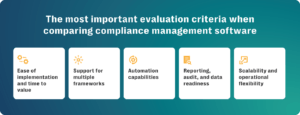
Here are the most important evaluation criteria when comparing compliance management software:
Ease of implementation and time to value
Traditional enterprise compliance platforms are often difficult to implement and maintain. Organizations increasingly prioritize platforms that offer:
- No-code or low-code configuration
- Faster deployment timelines
- Flexible workflows
- Reduced IT dependency
- Simplified administration
The ability to adapt workflows quickly becomes especially important as regulations evolve.
Support for multiple frameworks
As compliance programs mature, organizations often need to manage overlapping regulatory obligations across multiple business units, geographies, and operational environments. Look for software that supports:
- SOC 2
- ISO 27001
- HIPAA
- GDPR
- PCI DSS
- SOX
- NIST
- Custom frameworks
The strongest platforms also help organizations reuse controls and map overlapping requirements across frameworks, reducing duplication.
Automation capabilities
Automation reduces administrative burden while improving consistency and accountability. Key automation capabilities include:
- Evidence collection
- Assessment workflows
- Control testing
- Notifications and escalations
- Issue tracking
- Remediation management
- Regulatory change workflows
Reporting, audit, and data readiness
Executives and regulators increasingly expect real-time visibility into compliance performance. Organizations also need access to reliable, actionable data to evaluate control effectiveness and maintain a clear understanding of their overall compliance posture. Organizations should prioritize platforms that support:
- Executive dashboards
- Cross-functional reporting
- Audit-ready documentation
- Trend analysis
- Continuous monitoring
- Operational metrics
- Real-time compliance data and analytics
- Data readiness for audits, regulatory reviews, and internal assessments
Businesses looking to improve visibility and decision-making often prioritize platforms with real-time compliance monitoring capabilities that support proactive risk identification, stronger control validation, operational resilience, and faster response to evolving compliance requirements.
Scalability and operational flexibility
Many organizations outgrow compliance point solutions as programs mature. The best compliance software solutions support:
- Cross-functional collaboration
- Enterprise-wide scalability
- Workflow adaptability
- Connected operational visibility
- Long-term growth
 |
Top Governance, Risk, and Compliance Platforms to Consider in 2026
Review leading GRC software for managing risk, compliance, audits, controls, policies, and reporting across a more connected governance program. |
How AI is changing compliance management software
AI in compliance is evolving quickly, but practical adoption looks very different from the hype surrounding AI tools. The strongest compliance management software platforms embed AI as an operational layer rather than treat it as a standalone feature. That distinction matters. Organizations that attempt to layer AI onto fragmented systems often struggle with inconsistent outputs, unreliable reporting, and governance concerns. Practical AI in compliance management focuses on improving operational efficiency while keeping humans fully involved in oversight and decision-making.
Common AI use cases include:
- Summarizing regulatory updates
- Mapping overlapping requirements across frameworks
- Supporting control creation and reuse
- Identifying potential control gaps
- Improving consistency in assessments
- Reducing manual administrative work
- Accelerating reporting processes
The most effective AI-enabled compliance management solutions also prioritize:
- Transparent outputs
- Auditability
- Human review workflows
- Governance controls
- Operational explainability
AI works best when it operates on connected, structured data with clearly defined workflows.
Organizations evaluating embedded automation often explore how AI in compliance workflows can improve efficiency, reduce manual effort, and support more consistent reporting without removing human oversight.
 |
Top AI Compliance Software in 2026
|
Why compliance management becomes more difficult as programs scale
As compliance programs grow, organizations must manage more regulatory requirements, frameworks, controls, evidence, and remediation activities. When these processes are spread across disconnected systems, maintaining consistent oversight becomes increasingly difficult.
Common challenges include:
- Increasing regulatory complexity: Overlapping requirements across frameworks and jurisdictions create more work around regulatory updates, control mapping, evidence, and remediation.
- Manual compliance processes: Reliance on spreadsheets, email, shared drives, and manual evidence collection increases administrative effort and can contribute to inconsistent tracking.
- Limited visibility: Disconnected controls, issues, incidents, and remediation activities make it harder to identify compliance gaps and understand overall compliance status.
- Reactive audit preparation: Fragmented evidence and reporting can lead to last-minute evidence collection, inconsistent documentation, and more resource-intensive audits.
- Operational silos: Separating compliance from risk, audit, security, and operational workflows can limit collaboration and executive visibility.
As these challenges grow, organizations may face missed obligations, duplicated controls, audit delays, higher administrative costs, and longer remediation timelines. Compliance management software can help centralize these activities, automate workflows, and improve visibility across compliance programs.
Teams planning a long-term investment should also consider the broader benefits of compliance management software, including how connected workflows can reduce administrative burden and support more scalable compliance programs.
How to choose the right compliance management software
The right compliance management software depends on organizational complexity, regulatory exposure, operational maturity, and long-term scalability goals.
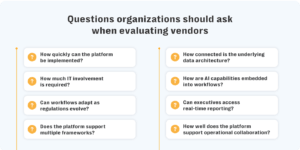
When evaluating vendors, organizations should ask:
- How quickly can the platform be implemented?
- How much IT involvement is required?
- Can workflows adapt as regulations evolve?
- Does the platform support multiple frameworks?
- How connected is the underlying data architecture?
- How are AI capabilities embedded into workflows?
- Can executives access real-time reporting?
- How well does the platform support operational collaboration?
Organizations should also evaluate whether platforms support integrated compliance management rather than isolated audit or policy workflows.
Connected systems typically provide stronger:
- Operational visibility
- Workflow consistency
- Cross-functional coordination
- Executive reporting
- Audit readiness
- Scalability
Compliance leaders also increasingly prioritize cultural adoption.
Building effective compliance programs requires more than software implementation alone — it depends on organizational accountability, visibility, and participation across teams.
Many organizations strengthening enterprise-wide engagement focus on building a strong compliance culture that reinforces shared responsibility across the business.
Also Read: Top SOX Compliance Software Reviewed for 2026
Why organizations choose Resolver for connected compliance management
Resolver helps organizations replace disconnected systems, siloed teams, and reactive processes with a more unified approach to compliance management.
By connecting compliance workflows with broader risk and operational processes, Resolver gives teams greater visibility into regulatory obligations, control effectiveness, remediation activities, and emerging issues.
This connected approach helps organizations:
- Eliminate duplicated controls and redundant work across frameworks
- Simplify framework mapping and reduce compliance complexity
- Identify compliance gaps and operational exposure earlier
- Accelerate remediation and response times
- Improve executive visibility with centralized reporting and real-time insights
- Strengthen collaboration across business units
- Scale compliance programs without significantly increasing administrative overhead
Resolver’s embedded AI capabilities also help reduce the manual burden associated with evidence collection, documentation management, and ongoing monitoring while still maintaining transparency and human oversight throughout the compliance lifecycle.
As regulatory requirements evolve, Resolver’s no-code flexibility allows teams to quickly adapt workflows, controls, and reporting processes without relying on lengthy IT development cycles or costly system reconfiguration projects.
For example, Equitable Bank used Resolver to centralize its compliance monitoring and testing program, bringing planning and control-related activities into one platform. As Tim Wong, Associate Director, Regulatory Compliance Management Monitoring and Testing, described the goal: “a holistic monitoring and testing program that was centralized in one platform.”
By bringing compliance, risk, and operational data into a more unified environment, organizations can improve coordination across:
- Compliance
- Risk management
- Internal audit
- Security
- Investigations
- Incident management
This more connected model helps organizations move from reactive compliance management toward a more proactive, resilient, and operationally aligned approach to governance and risk oversight.
For example, motusbank replaced spreadsheet-based compliance processes with Resolver to centralize compliance data, automate regulatory monitoring, and improve reporting across the organization. Its Chief Compliance Officer described the result simply: “motusbank now has a scalable system that delivers the right data.”
This reflects a broader shift happening across enterprise compliance programs. Organizations increasingly need connected systems that support operational resilience, visibility, and long-term scalability alongside audit preparation.
Take the next step toward scalable compliance management with Resolver
Compliance management is no longer just about passing audits.
Organizations today must manage growing regulatory complexity, increasing operational risk exposure, and rising expectations for real-time visibility across the business.
Manual processes and disconnected systems make it increasingly difficult to sustain.
The best compliance management software solutions help organizations centralize workflows, automate repetitive tasks, improve audit readiness, and connect compliance activities with broader operational risk management.
AI is also becoming an important part of modern compliance programs, but meaningful results depend on connected data, transparent workflows, and operational context.
Resolver stands out by combining:
- Unified compliance management
- Connected risk and control visibility
- Embedded AI workflows
- No-code flexibility
- Cross-functional operational support
- Scalable enterprise architecture
The result is a more connected, efficient, and resilient compliance program that helps organizations move beyond reactive compliance management toward proactive operational oversight.
To learn how organizations are modernizing compliance operations with connected workflows, embedded AI, and scalable reporting capabilities, teams can explore Resolver’s compliance management showcase.
Frequently Asked Questions About Compliance Management Software
What is compliance management software?
Compliance management software helps organizations manage regulatory requirements, policies, controls, and compliance activities in one place. It automates workflows, simplifies reporting, and improves visibility across compliance programs.
Who uses compliance management software?
Compliance, risk, audit, security, legal, and operational teams use compliance management software to coordinate regulatory activities, assign responsibilities, monitor controls, manage evidence, and report on compliance performance.
What is the difference between compliance management software and GRC software?
Compliance management software primarily supports regulatory obligations, controls, policies, evidence, and reporting. GRC software typically covers a broader range of governance, risk, compliance, audit, and operational processes within one platform.
How does compliance management software improve compliance tracking?
Compliance management software centralizes compliance activities, automates workflows, tracks controls and regulatory requirements, and provides real-time reporting. This gives organizations better visibility into compliance status, reduces manual effort, and helps identify gaps before they become larger issues.
Can compliance software support multiple regulatory frameworks?
Yes. Many platforms support multiple frameworks and allow organizations to map shared requirements and controls across standards such as SOC 2, ISO 27001, HIPAA, GDPR, PCI DSS, SOX, and NIST.
How much does compliance management software cost?
Pricing varies based on the number of users, frameworks, business units, integrations, and capabilities required. Many regulatory compliance vendors provide customized pricing rather than fixed public plans.