Top SOX Compliance Software for Scalable Compliance Programs
A practical guide to choose the right SOX compliance software to centralize ICFR controls, streamline testing, manage evidence, track deficiencies, and improve reporting.


Sarbanes-Oxley (SOX) compliance has become increasingly difficult to manage through spreadsheets, email chains, and disconnected systems. Public companies must demonstrate effective internal controls over financial reporting (ICFR) while coordinating testing, evidence collection, remediation, and reporting across multiple stakeholders.
As regulatory compliance programs grow, manual processes often create visibility gaps, increase audit preparation effort, and make it harder to maintain accountability.
SOX compliance software helps organizations centralize controls, automate workflows, streamline evidence collection, and improve audit readiness. In this guide, we’ll review leading SOX compliance software solutions and outline the key capabilities organizations should evaluate when selecting a platform.
Why organizations invest in SOX compliance software?
Many organizations begin their SOX compliance journey using spreadsheets, email workflows, and shared drives. While these approaches may be sufficient for smaller programs, growing organizations need more than a centralized repository for controls and evidence.
Common challenges include:
- Managing an expanding control environment across finance, ERP, HRIS, identity and access management, and IT general controls (ITGCs)
- Demonstrating control effectiveness throughout the year (not just during audit season)
- Coordinating control owners, evidence collection, and testing activities across multiple business functions
- Identifying, tracking, and remediating control deficiencies within increasingly rigorous regulatory and management expectations
- Providing executives and the board with meaningful visibility into control performance, emerging risks, and remediation progress
- Keeping pace with evolving internal control requirements, including expanding governance expectations such as the UK Corporate Governance Code’s Provision 29 and other global regulatory developments
Effective SOX compliance software builds a stronger internal control environment that supports accountability, operational performance, and informed decision-making.
Further, the right SOX compliance platform helps teams understand where controls are working, where coverage gaps or deficiencies exist, and which issues require immediate attention. By connecting controls, risks, testing activities, remediation efforts, and reporting in a single system, organizations gain greater visibility into the health of their control environment. This allows compliance, finance, and risk teams to identify recurring issues earlier, prioritize remediation more effectively, and provide leadership with meaningful insights that strengthen governance across the business.
For organizations operating in multiple jurisdictions, regulatory requirements are also evolving. Understanding frameworks such as What C-SOX Means for Canadian Companies can help compliance teams prepare for changing expectations.
Top SOX compliance software solutions reviewed
The best SOX compliance software platforms help organizations move beyond fragmented compliance processes and establish a more structured, scalable approach to managing controls, testing, evidence, deficiencies, and audit readiness.
The following solutions are among the most commonly evaluated platforms on the market today.
1. Resolver
Best for: Organizations seeking connected compliance, risk, controls, issues, and remediation management
Resolver takes a connected approach to SOX compliance management by linking controls, risks, testing activities, findings, remediation efforts, and reporting within a single platform.
Many organizations struggle because compliance information is scattered across multiple systems. Controls are documented in one place, testing results in another, remediation activities in a third, and risk assessments in a fourth. This fragmentation often creates visibility gaps and increases the administrative burden placed on audit and compliance teams.
Key features include:
- Centralized control inventories
- Financial and IT control documentation
- Risk-to-control mapping
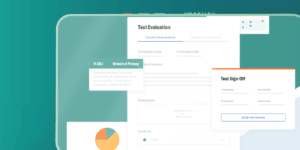
- Testing workflow management
- Evidence collection and management
- Deficiency and issue tracking
- Corrective action monitoring
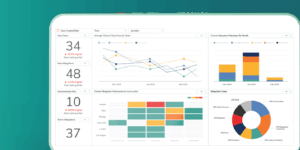
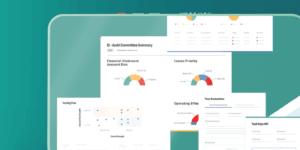
- Executive reporting dashboards
- Embedded AI capabilities
One area where Resolver stands apart is its ability to connect deficiencies directly to remediation activities. Instead of tracking issues in separate spreadsheets or disconnected systems, teams can monitor ownership, progress, and accountability throughout the remediation lifecycle.
Resolver’s embedded AI capabilities are designed to support compliance professionals rather than replace them. AI can help streamline control mapping, identify potential control gaps, improve documentation workflows, summarize findings, and accelerate reporting activities while maintaining transparency and human oversight.
Organizations also benefit from flexibility. Compliance teams can adapt workflows, testing methodologies, reporting structures, and framework requirements without extensive IT involvement.
For organizations looking beyond standalone SOX programs, Resolver provides a foundation that can scale into broader compliance, risk management, and operational resilience initiatives.
Key strengths:
- Connected compliance and risk visibility
- Strong remediation oversight
- Flexible configuration
- Executive reporting capabilities
- AI-assisted workflow efficiencies
- Scalability beyond SOX
Cons:
- May be more than needed for teams focused only on basic SOX testing and evidence collection.
Pricing: Contact vendor for pricing.
2. Optro
Best for: Organizations modernizing spreadsheet-based SOX programs
Optro, formerly known as AuditBoard, remains one of the most widely recognized platforms for SOX compliance and audit management.
Many organizations first evaluate AuditBoard when looking to replace spreadsheet-driven control management processes. The platform focuses heavily on streamlining control documentation, testing, evidence collection, and audit workflows.
Key features include:
- SOX controls management
- Risk assessment support
- Testing workflows
- Evidence requests
- Audit management
- Reporting dashboards
AuditBoard’s strong market presence means many auditors and compliance professionals are already familiar with its workflows and capabilities.
The platform is particularly well-suited for organizations seeking a dedicated SOX and audit management solution without necessarily requiring a broader enterprise risk management platform.
Cons:
- May require additional platforms for broader risk management initiatives
- Some organizations may seek deeper integration between compliance and operational risk activities
Pricing: Contact Optro for custom pricing.
3. Workiva
Best for: Finance and reporting teams seeking connected compliance and reporting capabilities
Workiva has established itself as a leading platform for financial and regulatory reporting, as well as compliance collaboration.
Many organizations use Workiva to manage reporting requirements and support SOX compliance through integrated documentation, workflows, and evidence management.
Key features include:
- Connected reporting environment
- Compliance documentation
- Collaboration tools
- Workflow management
- Evidence management
- Reporting automation
Workiva’s strength lies in integrating reporting and compliance processes into a collaborative environment.
Finance teams often appreciate the ability to manage disclosures, reporting documentation, and compliance workflows from a centralized platform.
Cons:
- Organizations seeking deeper compliance management functionality may evaluate additional solutions
- Risk management capabilities may not be the primary focus for every deployment
Pricing: Contact Workiva for custom pricing.
4. Diligent
Best for: Internal audit teams seeking governance, audit, and compliance functionality
Diligent offers a broad governance, risk, audit, and compliance platform used by organizations worldwide.
The platform is frequently adopted by organizations seeking stronger alignment between internal audit, compliance, and governance activities.
Key features include:
- Audit management
- Compliance workflows
- Risk assessments
- Board reporting support
- Governance capabilities
- Issue management
Diligent’s governance capabilities can be particularly attractive for organizations looking to improve board-level visibility into audit and compliance activities.
Cons:
- Organizations primarily focused on SOX compliance may not require all available governance functionality
- Some implementations may require greater configuration depending on organizational requirements
Pricing: Contact vendor for pricing.
5. MetricStream
Best for: Large enterprises with mature governance and compliance programs
MetricStream is one of the most established enterprise GRC platforms in the market.
Large organizations often evaluate MetricStream when they require extensive capabilities in governance, risk, compliance, audit, and policy management.
Key features include:
- Enterprise GRC management
- SOX compliance support
- Risk management
- Policy management
- Audit management
- Regulatory compliance workflows
MetricStream is often favoured by organizations with complex governance structures, multiple business units, and mature risk management programs.
Cons:
- Implementation and administration can be resource-intensive
- Smaller compliance teams may find certain capabilities exceed immediate requirements
Pricing: Contact vendor for pricing.
6. ArcherIRM
Best for: Organizations requiring extensive customization
ArcherIRM, formerly known as RSA Archer, remains a longstanding player within the enterprise GRC market.
The platform is known for its configurability and ability to support highly customized governance and compliance programs.
Key features include:
- Compliance management
- Risk management
- Control management
- Audit workflows
- Issue management
- Regulatory tracking
Organizations with unique workflows or specialized governance requirements often appreciate Archer’s flexibility.
Cons:
- Greater configurability can create additional implementation complexity
- Ongoing administration may require dedicated resources
Pricing: Contact vendor for pricing.
7. ServiceNow GRC
Best for: Organizations already invested in the ServiceNow ecosystem
ServiceNow GRC extends the broader ServiceNow platform to support governance, risk, and compliance activities.
Organizations already using ServiceNow for IT service management frequently evaluate its compliance capabilities to leverage existing workflows and integrations.
Key features include:
- Compliance management
- Policy management
- Risk management
- Workflow automation
- Control testing support
- Integrated reporting
One of ServiceNow’s strongest advantages is workflow automation. Organizations already operating within the ServiceNow ecosystem can often extend existing processes into compliance management activities.
Cons:
- Organizations not currently using ServiceNow may face a larger implementation footprint
- Certain compliance requirements may require additional configuration
Pricing: Contact vendor for pricing.
Discover Resolver's solutions.
SOX compliance software comparison table
The following comparison provides a high-level overview of the leading SOX compliance software solutions discussed above.
|
Platform |
Best for |
Strengths |
Limitations |
|
Resolver |
Mid-market and enterprise SOX programs |
Connected compliance management, integrated remediation tracking, AI-assisted workflows, flexible configuration |
Organizations seeking only basic SOX testing tools may not require broader compliance and risk capabilities |
|
Optro |
Organizations replacing spreadsheets
|
Strong SOX workflows, evidence collection, and audit management |
Primarily focused on audit and compliance, broader risk management often requires additional tools or integrations |
|
Workiva |
Finance and reporting teams |
Reporting, collaboration, document management, and connected reporting |
Compliance management depth may be limited compared to dedicated GRC and compliance platforms |
|
Diligent |
Internal audit and governance teams |
Audit management, governance oversight, board reporting |
Governance-focused functionality may exceed the needs of organizations seeking a dedicated SOX solution |
|
Metricstream |
Large enterprises |
Enterprise scalability, broad GRC capabilities, and regulatory compliance coverage |
Resource-intensive implementation and administration; typically best suited for mature compliance programs |
|
ArcherIRM |
Highly customized compliance environments |
Extensive configurability, flexible workflows, and broad GRC functionality |
Higher complexity and administration often require dedicated platform resources and longer implementation timelines |
|
ServiceNow GRC |
Existing ServiceNow customers
|
Workflow automation, ecosystem integration, centralized compliance processes |
Additional configuration and licensing may be required to support complex SOX compliance programs |
While examining available options, it’s critical to look beyond high-level features and consider your organization’s needs, including current pain points.
What to look for in SOX compliance software?
Not all SOX compliance software offers the same capabilities. Some solutions focus primarily on testing and audit workflows, while others provide a broader framework for managing controls, risks, deficiencies, remediation activities, and regulatory requirements.
As organizations prepare for evolving compliance requirements in multiple jurisdictions, including emerging UK SOX regulations, maintaining visibility into internal controls and reporting processes becomes increasingly important
When evaluating SOX compliance solutions, organizations should prioritize the following capabilities.
Connected control management
A centralized control inventory is the foundation of an effective SOX compliance program.
The right platform should allow teams to:
- Document financial and IT controls
- Assign ownership and accountability
- Maintain an RACM that links financial reporting to key controls
- Maintain control hierarchies
- Track changes over time
- Standardize control documentation
 |
Top Compliance Management Sofware to Consider in 2026 |
Risk and control mapping
Modern SOX programs increasingly adopt top-down, risk-based approaches to compliance.
Risk and control mapping helps organizations:
- Link risks directly to controls
- Maintain traceability between assessments and controls
- Support auditor expectations
- Identify control gaps more efficiently
- Demonstrate coverage across key financial processes
Testing workflow management
Testing is often one of the most resource-intensive aspects of SOX compliance.
Organizations should look for solutions that support:
- Test planning and scheduling
- Automated assignments
- Reminder notifications
- Testing documentation
- Review and approval workflows
Evidence collection and document management
Evidence collection remains one of the biggest sources of frustration for compliance teams.
Strong SOX compliance software should provide:
- Centralized evidence repositories
- Manage PBC requests in one place
- Automated evidence requests
- Version control
- Audit trails
- Secure documentation management
Deficiency and remediation management
Identifying deficiencies is only part of the compliance process.
Organizations must also be able to:
- Document findings
- Support deficiency evaluation
- Perform root cause analysis
- Assign corrective actions
- Track remediation progress
- Monitor overdue activities
Reporting and executive visibility
Compliance leaders need to communicate program performance to management, audit committees, and boards.
Effective reporting capabilities should provide visibility into:
- Testing progress
- Open deficiencies
- Remediation status
- Control effectiveness
- Overall compliance health
AI-enabled compliance workflows
AI is becoming an increasingly valuable tool for compliance teams, particularly those operating with limited resources.
The most effective AI capabilities support risk and compliance professionals by helping them:
- Analyze control coverage
- Identify potential control gaps
- Support documentation activities
- Summarize findings and assessments
- Improve reporting efficiency
 |
Top Governance, Risk, and Compliance Platforms to Consider in 2026Review leading GRC software for managing risk, compliance, audits, controls, policies, and reporting across a more connected governance program. |
Where manual SOX processes break down?
Many organizations still manage SOX activities through spreadsheets, email, and shared drives. As compliance programs grow, these manual processes become increasingly difficult to sustain.
Spreadsheet-based control tracking becomes difficult to scale
Spreadsheets remain common within SOX programs, but they introduce challenges as control environments become more complex.
Common issues include:
- Version control problems
- Duplicate documentation
- Inconsistent updates
- Limited accountability
- Difficulty tracking ownership
As the number of controls increases, maintaining accurate information manually becomes increasingly time-consuming.
Evidence collection consumes valuable time
Many audit and compliance teams spend weeks coordinating evidence requests across departments.
This often results in:
- Repetitive follow-ups
- Email overload
- Missing documentation
- Delayed testing
- Increased audit preparation effort
Centralized evidence collection workflows can dramatically reduce this administrative burden.
Testing activities create operational bottlenecks
Without automation, testing activities often rely on manual scheduling, tracking, and coordination.
Teams may struggle to answer basic questions such as:
- Which controls have been tested?
- Which tests are overdue?
- Where are supporting documents stored?
- Which findings remain unresolved?
These visibility gaps can slow audits and increase compliance risk.
Deficiencies are identified too late
When deficiencies are tracked separately from remediation activities, organizations may not discover issues until late in the audit cycle.
This can create:
- Increased remediation costs
- Resource constraints
- Audit delays
- Greater management scrutiny
Connecting issues, owners, corrective actions, and reporting within a single platform improves accountability and remediation outcomes.
How SOX compliance software supports audit readiness?
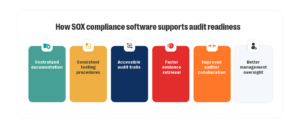
Maintaining audit readiness throughout the year is one of the primary reasons organizations invest in SOX compliance software.
Rather than scrambling to prepare for audits, teams can establish repeatable processes to support ongoing compliance.
Key benefits include:
- Centralized ICFR documentation
- Clear control ownership and accountability
- Consistent design and testing procedures
- PBC request and evidence tracking
- Accessible audit trails for testing, review, and approvals
- Faster evidence retrieval
- Deficiency evaluation and remediation tracking
- Improved auditor collaboration
- Better management oversight
- AI-assisted automation and intelligence support
When controls, testing results, evidence, deficiencies, and remediation activities are maintained within a single system, organizations can respond to auditor requests more efficiently and reduce preparation effort.
Organizations seeking to strengthen their internal control programs can learn more in Mastering ICFR and SOX Compliance.
How to choose the right SOX compliance software?
The best SOX compliance software depends on the complexity of your control environment, organizational structure, compliance maturity, and long-term governance objectives.
The following considerations can help guide the evaluation process.
Understand your compliance program maturity
Organizations should first assess:
- Number of controls
- Number of business units
- Regulatory requirements
- Internal audit resources
- Existing technology environment
A solution that works well for a growing public company may differ significantly from what a global enterprise requires.
Evaluate scalability beyond SOX
While SOX may be the immediate priority, many organizations eventually expand into broader compliance and risk management initiatives.
This may include:
- Regulatory compliance
- Enterprise risk management
- Policy management
- Third-party risk management
Selecting a platform that can evolve alongside organizational needs may reduce future technology investments.
Organizations navigating international compliance requirements may also benefit from understanding UK SOX 2025: Strengthening Internal Controls as regulatory expectations continue to evolve across global markets.
Consider usability for business stakeholders
Control owners, process owners, finance teams, and business leaders all contribute to SOX compliance activities.
Solutions should support:
- Intuitive workflows
- Simple evidence submission
- Minimal training requirements
- Broad stakeholder adoption
The easier the platform is to use, the more likely organizations are to achieve consistent participation across the business.
Assess reporting and executive visibility
Executives, boards, and audit committees increasingly expect timely insights into compliance performance.
Organizations should evaluate:
- Dashboard capabilities
- Audit committee reporting
- Remediation reporting
- Deficiency tracking
- Risk visibility
Strong reporting helps leadership make informed decisions and allocate resources effectively.
Evaluate implementation and administration requirements
Not all platforms require the same level of administrative effort.
Key considerations include:
- Configuration requirements
- Internal resource availability
- Ongoing maintenance needs
- Scalability requirements
The right balance often depends on organizational complexity and available compliance resources.
|
|
Top Enterprise Risk Management Tools in 2026Explore the leading ERM software which will simplify risk management with automation, connected workflows, dashboards, and reporting, helping teams save time, improve risk visibility, and make better informed decisions. |

How Resolver helps streamline SOX compliance management?
For many organizations, the challenge isn’t simply managing SOX controls. It’s maintaining visibility across controls, risks, deficiencies, remediation activities, and reporting obligations.
Resolver helps organizations connect these activities within a unified compliance management platform.
With Resolver, teams can:
- Centralize control documentation
- Connect risks and controls
- Streamline testing activities
- Automate evidence collection workflows
- Track deficiencies and corrective actions
- Improve accountability across stakeholders
- Deliver executive-level compliance reporting
Resolver’s embedded AI capabilities help compliance teams improve efficiency by supporting control mapping, identifying potential gaps, streamlining documentation activities, and accelerating reporting workflows.
Unlike standalone SOX tools, Resolver enables organizations to understand how compliance activities relate to broader operational and regulatory risks.
Organizations can also extend compliance programs beyond SOX to support frameworks and standards such as:
- SOC 2
- ISO 27001
- NIST
- GDPR
- HIPAA
- PCI DSS
Resolver can also support financial services regulations and guidance from organizations, including:
- OSFI
- FFIEC
- SEC
- FINRA
- FCA
- OCC
SOX activity
What teams need
How resolver Supports
Scoping and risk assessment
Identify in-scope processes, systems, entities, and financial statement risks
Connect risks, requirements, controls, and business context, giving teams a single source of truth and maximized visibility
RACM/control library
Maintain clear control ownership, frequency, evidence, and control objectives
Centralized, configurable control inventory with AI assisted control recommendation and generation
Control mapping and gap analysis
Link risks, requirements, and controls to show coverage across key financial processes
AI-supported gap analysis and risk-to-control mapping to improve coverage visibility
Testing
Manage design and operating effectiveness testing
Workflow, assignments, approvals, and audit trail
Evidence collection
Reduce manual PBC requests and follow-ups
Centralized evidence requests and documentation
Deficiency evaluation
Track findings, severity, root cause, and impact
Deficiency and issue management
Remediation
Assign owners, due dates, corrective actions, and progress
Connected corrective action monitoring
Reporting
Give audit committees and executives visibility
Dashboards and executive reporting
Organizations seeking a more connected approach to compliance management can explore Resolver’s compliance management platform.
Frequently asked questions
What is SOX compliance software?
SOX compliance software helps organizations manage internal controls over financial reporting by centralizing control documentation, testing activities, evidence collection, issue management, remediation tracking, and audit reporting.
What are the best SOX compliance software tools?
Popular SOX compliance software solutions include Resolver, AuditBoard (Optro), Workiva, Diligent, MetricStream, RSA Archer, and ServiceNow GRC. The best choice depends on an organization’s compliance requirements, resources, governance maturity, and long-term objectives.
How does SOX compliance software improve audit readiness?
SOX compliance software improves audit readiness by centralizing documentation, maintaining audit trails, streamlining testing workflows, automating evidence collection, and providing real-time visibility into compliance activities.
Can SOX compliance software help manage IT controls?
Yes. Most modern SOX compliance solutions support both financial and IT controls, allowing organizations to manage testing, documentation, evidence collection, and reporting from a centralized platform.
What features should organizations prioritize in SOX compliance software?
Organizations should prioritize control management, risk-to-control mapping, testing workflows, evidence collection, deficiency management, reporting capabilities, automation, and scalability.
Can SOX compliance software support frameworks beyond SOX?
Many compliance management platforms support additional frameworks and regulations, including SOC 2, ISO 27001, NIST, GDPR, HIPAA, PCI DSS, and industry-specific regulatory requirements.
Simplify SOX compliance with connected compliance management
SOX compliance continues to grow more complex as organizations face expanding control environments, increasing regulatory expectations, and ongoing pressure to maintain audit readiness.
Manual processes built around spreadsheets, emails, and disconnected systems often struggle to provide the visibility, consistency, and accountability that modern compliance programs require.
The right SOX compliance software can help organizations centralize controls, streamline testing, simplify evidence collection, improve remediation oversight, and strengthen reporting across the business.
Organizations seeking a more connected approach to SOX compliance can explore Resolver’s Compliance Management Software to see how unified compliance workflows improve audit readiness, visibility, and accountability.