Top Operational Risk Management Software for Smarter Risk Decisions
Review top operational risk management software that helps teams connect risk data, streamline workflows, and strengthen resilience across the organization.

Operational risk continues to grow in complexity. In 2026, organizations are facing increasing regulatory requirements, operational disruptions, third-party dependencies, and ever-changing business risks.
Yet many teams still rely on spreadsheets, disconnected systems, and manual processes, making it difficult to gain a complete view of operational risk exposure.
Operational risk management software is, in many ways, the solution. It helps organizations move from manual and reactive risk tracking to a more connected, risk-informed operating model. The strongest platforms centralize risk and control data, streamline RCSAs, capture operational risk events, monitor KRIs, track remediation, and provide leadership with a clearer view of emerging risk trends.
TL;DR
-
Operational risk management software helps organizations centralize risk data, assessments, controls, incidents, and reporting.
-
Core capabilities often include RCSAs, KRI monitoring, risk event capture, control testing, remediation tracking, and workflow automation.
-
Leading operational risk software differ in workflow flexibility, analytics, automation, integrations, and scalability.
-
Selection should be based on your organization’s current risk processes, reporting needs, risk profile, and future growth.
-
The right software should improve visibility into operational risk and make it easier to track, assess, and respond to emerging issues.
In this guide, we’ll review some of the top operational risk management software solutions available today, including their strengths, limitations, and ideal use cases.
What is operational risk management software?
Operational risk management software helps organizations identify, assess, monitor, and mitigate risks that arise from people, processes, systems, third parties, and external events.
Rather than managing risks through disconnected processes, organizations can use operational risk management tools to create a centralized system of record for:
- Risks
- Controls
- Risk assessments
- Operational risk events
- Issues and findings
- Action plans
- Loss events
- Business processes
- Supporting documentation
- RCSAs
- KRIs and risk indicators
- Root cause analysis
- Control effectiveness testing
- Remediation and corrective action plans
- Operational resilience activities
Modern operational risk management solutions also help organizations automate workflows, improve accountability, and generate reporting for management, auditors, regulators, and boards.
For financial institutions in particular, operational risk management software plays a critical role in supporting regulatory compliance, operational resilience, governance, and risk-informed decision-making.
 |
Top Enterprise Risk Management Tools in 2026Explore the leading ERM software which will simplify risk management with automation, connected workflows, dashboards, and reporting, helping teams save time, improve risk visibility, and make better informed decisions. |
Discover Resolver's solutions.
Biggest challenges operational risk management software solves
Many organizations invest in operational risk management software because manual processes become difficult to sustain as risk programs mature.
Here are some of the most common challenges these platforms help address.
Fragmented risk information
One of the biggest challenges facing risk teams is disconnected data.
Risk events, incidents, controls, assessments, and remediation activities are often managed across multiple systems. This fragmented approach makes it difficult to understand relationships between risks, identify recurring issues, measure the effectiveness of mitigation efforts, and maintain consistent RCSA processes across the organization.
Modern operational risk management tools connect these data points within a single platform, helping organizations understand not only what happened, but why it happened and what should happen next.
By creating a connected view of operational risk, teams can improve decision-making, strengthen operational resilience, and standardize risk management practices across the business.
Limited visibility into emerging risks
Operational risk signals frequently originate from frontline employees and business units.
Without a structured process for capturing and escalating issues, organizations may not recognize developing risks until they become significant incidents.
Operational risk management software helps organizations collect information from across the business, route issues to the appropriate stakeholders, and improve visibility into emerging risk trends.
Manual risk assessments
Many organizations continue to conduct risk assessments using spreadsheets and email submissions.
This approach creates inconsistencies across business units and requires significant manual effort to collect, validate, and consolidate information.
Organizations looking to strengthen their risk assessment process can benefit from standardized workflows, scoring methodologies, and centralized reporting that improve consistency and efficiency.
Difficulty measuring control effectiveness
Documenting controls is only one part of effective operational risk management. Organizations also need visibility into whether controls are functioning as intended. Otherwise, teams discover control failures only after incidents occur, creating unnecessary risk exposure.
Operational risk management software helps organizations map controls to risks, document testing activities, track deficiencies, and improve oversight of control effectiveness.
Reporting and governance challenges
Executives, boards, auditors, and regulators require timely risk information.
Unfortunately, reporting often involves manually gathering information from multiple sources and creating presentations by hand.
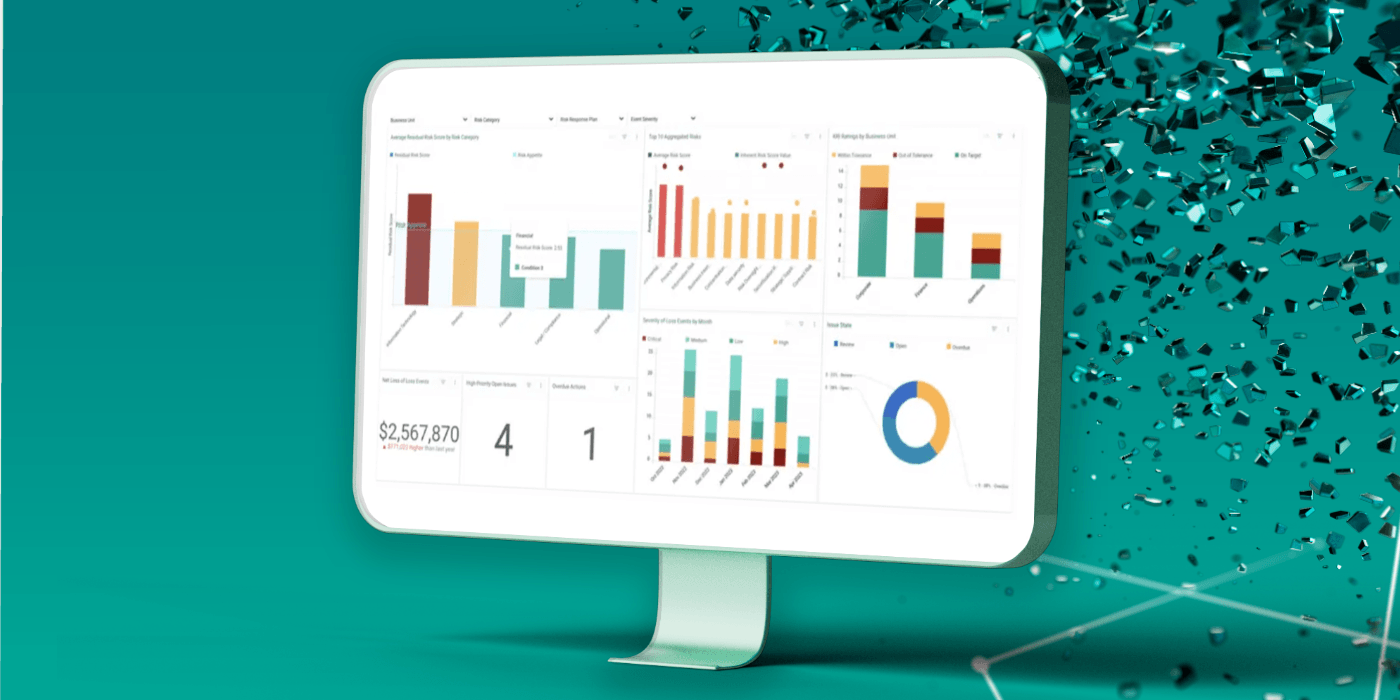
Operational risk management solutions streamline reporting through dashboards, automated reporting workflows, trend analysis, and centralized risk information.
Scaling risk programs with lean teams
Mid-market financial institutions face a unique challenge: Risk expectations continue to grow, but headcount often does not. This limitation causes friction, as visibility, oversight, and reporting must be strengthened without significantly increasing resources.
Operational risk management software helps automate routine activities, reduce administrative burden, and support program growth without requiring additional staffing.
Top operational risk management software tools reviewed
1. Resolver
Best for: Mid-market financial institutions seeking connected operational risk management and operational resilience.
Resolver takes a connected approach to operational risk management by bringing risks, controls, incidents, issues, assessments, remediation activities, and business operations together within a unified platform.
Rather than treating risk management as a collection of separate activities, Resolver helps organizations understand how risk information relates across the enterprise.
This connected visibility can help risk teams identify recurring issues, understand downstream impacts, improve accountability, and make faster decisions.
Key features:
- Connected risk, control, incident, and issue management
- Operational risk event capture and workflow management
- Risk assessment automation
- Action and remediation tracking
- Executive and board reporting
- Operational resilience support
- Embedded AI capabilities for risk workflows
- Flexible configuration without extensive IT involvement
One of Resolver’s key differentiators is its ability to connect operational risk information from frontline teams with broader governance, risk, and resilience activities. Organizations can also extend these capabilities with Resolver’s dedicated Business Continuity Management (BCM) application, which provides deeper operational resilience planning, testing, and response. Together, Resolver’s ORM and BCM applications deliver comprehensive, enterprise-wide operational resilience coverage.
Organizations gain visibility into how incidents relate to controls, remediation efforts, business processes, and overall risk exposure, helping create a more complete picture of operational risk.
For teams seeking broader enterprise risk management software capabilities, Resolver’s connected approach can also support multiple risk domains within a single platform.
Resolver also offers implementation flexibility, as operational risk programs evolve alongside regulatory and business requirements. Risk teams can adapt workflows, taxonomies, and reporting structures without significant administrative overhead.
Organizations looking to break down operational risk silos may also find value in this financial services case study, which shows how connected risk information improved visibility and decision-making.
Limitations: Advanced enterprise deployments may require implementation planning
Ideal users:
- Credit unions
- Insurance providers
- Asset managers
- Financial services organizations
- Growing risk and compliance teams
Pricing: Contact vendor for pricing.
2. ArcherIRM
Best for: Large enterprises with mature GRC programs.
RSA Archer, which rebranded to Archer IRM (Integrated Risk Management), is one of the most established names in governance, risk, and compliance software.
The platform provides extensive functionality across operational risk, compliance, audit, third-party risk, and policy management.
Key features:
- Operational risk management
- Risk assessments
- Control management
- Compliance management
- Third-party risk capabilities
- Reporting and dashboards
Limitations:
- Longer implementation timelines
- Higher administrative overhead
- Greater complexity than many mid-market organizations require
Ideal users:
- Large enterprises
- Mature GRC programs
- Organizations with dedicated platform administration teams
Pricing: Contact RSA Archer for custom pricing. Costs vary based on deployment size, selected modules, user requirements, and implementation complexity.
3. MetricStream
Best for: Global organizations with complex governance and compliance requirements.
MetricStream offers broad risk and compliance functionality designed primarily for large enterprises.
The platform supports operational risk management, enterprise risk management, compliance management, internal audit, and regulatory change management.
Key features:
- Enterprise-scale risk management
- Operational risk assessments
- Compliance workflows
- Control management
- Regulatory tracking
- Analytics and reporting
Limitations:
- Can require significant implementation resources
- Better suited for larger organizations with mature risk programs
Ideal users:
- Global enterprises
- Financial institutions with extensive risk operations
- Organizations seeking a broad GRC platform
Pricing: Contact vendor for pricing.
4. ServiceNow GRC
Best for: Organizations already invested in the ServiceNow ecosystem.
ServiceNow GRC extends risk and compliance capabilities within the broader ServiceNow platform. For organizations that use ServiceNow extensively across IT, operations, and business workflows, the platform can provide robust integration and process automation capabilities.
Rather than operating as a standalone operational risk management solution, ServiceNow often forms part of a broader digital transformation initiative.
Key features:
- Integrated risk and compliance management
- Workflow automation
- Policy and control management
- Issue tracking
- Dashboard and reporting
- Integration with broader ServiceNow workflows
Limitations:
- Operational risk management is not the platform’s primary focus
- Organizations may require additional configuration to support specific operational risk requirements
- Can be complex for organizations not already using ServiceNow
Ideal users:
- Existing ServiceNow customers
- Large enterprises
- Organizations seeking unified workflow management
Pricing: Contact vendor for pricing.
5. LogicGate
Best for: Organizations seeking configurable risk management workflows.
LogicGate is known for its flexibility and workflow-driven approach to governance, risk, and compliance.
The platform allows organizations to build and customize workflows for risk management, compliance, third-party risk, and related processes.
This flexibility can be attractive for organizations with unique requirements, although some financial institutions may require additional operational risk capabilities and industry-specific configuration.
Key features:
- Highly configurable workflows
- Risk assessment management
- Issue management
- Process automation
- Reporting and dashboards
- No-code configuration capabilities
Limitations:
- May require additional customization for financial services use cases
- Operational risk functionality may require more configuration than purpose-built solutions
Ideal users:
- Organizations seeking workflow flexibility
- Mid-sized enterprises
- Teams with evolving governance requirements
Pricing: Contact vendor for pricing.
6. Riskonnect
Best for: Organizations focused on operational risk and resilience management.
Riskonnect has strong roots in operational risk management and is frequently evaluated by organizations seeking to improve risk visibility, resilience, and incident management.
The platform supports a wide range of risk management activities and is often considered alongside enterprise risk management solutions.
Key features:
- Operational risk management
- Incident management
- Risk assessments
- Business continuity support
- Reporting and analytics
- Resilience-focused capabilities
Limitations:
- User experience may feel dated compared to newer platforms
- Some organizations report a steeper learning curve for business users
Ideal users:
- Financial institutions
- Operational resilience programs
- Organizations seeking operational risk specialization
Pricing: Contact vendor for pricing.
7. Protecht
Best for: Organizations seeking a risk-focused platform with operational risk capabilities.
Protecht offers operational risk, compliance, and governance capabilities with an emphasis on usability and ease of implementation.
The platform is often viewed as more approachable than some enterprise-focused GRC solutions while still supporting operational risk management requirements.
Key features:
- Operational risk management
- Risk assessments
- Control management
- Incident management
- Reporting and dashboards
- Workflow automation
Limitations:
- Smaller platform breadth compared to some enterprise competitors
- Often more heavily associated with specific risk domains, such as third-party risk management
Ideal users:
- Mid-sized organizations
- Growing risk programs
- Teams seeking faster adoption
Pricing: Contact vendor for pricing.
Operational risk management software comparison table
Reviewing available software options, it’s critical to examine your organization’s priorities, risk profile, and potential deployment needs. When comparing operational risk management software, prioritize your organization’s risk profile, core use cases, and deployment requirements.
|
Platform |
Best for |
Strengths |
Limitations |
|
Resolver |
Mid-market financial institutions |
Connected risk data, operational resilience, flexible configuration |
Advanced enterprise deployments may require implementation planning |
|
ArcherIRM |
Large enterprises |
Extensive GRC capabilities |
Higher complexity and administration often require dedicated platform resources and longer implementation timelines |
|
MetricStream |
Global enterprises |
Broad risk and compliance coverage |
Resource-intensive implementations; typically best suited for organizations with mature risk programs |
|
ServiceNow GRC |
Existing ServiceNow customers |
Workflow integration and automation |
ORM is not the primary platform focus; additional configuration and licensing costs may be required |
|
LogicGate |
Configurable workflows |
Flexibility and no-code configuration |
May require additional operational risk customization; ongoing workflow maintenance can require internal expertise |
|
Riskonnect |
Operational resilience programs |
Strong operational risk heritage |
User experience considerations: Some users report a steeper learning curve for broader adoption |
|
Protecht |
Growing risk programs |
Faster adoption and ease of use |
More limited platform breadth; may not offer the same enterprise-wide coverage as larger GRC platforms |
Reviewing available resources or demos of software options can also help narrow down ideal options.
How AI is changing operational risk management?
Artificial intelligence is becoming an increasingly valuable component of operational risk management software.
However, the greatest value comes from AI capabilities built on connected, structured operational risk data.
When risk information exists across disconnected spreadsheets and systems, AI has limited context. When risks, incidents, controls, assessments, and remediation activities are connected, AI can help organizations uncover insights more efficiently.
Some of the most practical AI use cases include:
- Summarizing incident investigations
- Identifying recurring operational risk events
- Highlighting similar incidents across business units
- Supporting control mapping and documentation
- Identifying potential control gaps
- Analyzing risk trends
- Streamlining reporting and assessment activities
For lean risk teams, these capabilities can significantly reduce manual effort and improve consistency.
At the same time, AI should support, not replace, risk professionals.
Organizations should prioritize solutions that provide transparent, explainable outputs while maintaining human oversight, governance, and auditability.
How to select the right operational risk management software?
Choosing the right operational risk management solution requires more than comparing feature lists.
Organizations should evaluate platforms based on their ability to support current requirements while adapting to future program growth.
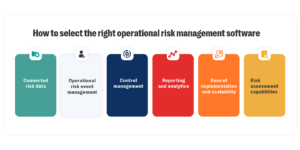
Key evaluation criteria include:
Connected risk data
Look for platforms that connect:
- Risks
- Controls
- Incidents
- Issues
- RCSA and assessment flexibility
- Action plans
- Owners
- Supporting documentation
- KRI and trend monitoring
- Root cause analysis
- Intentional AI use cases
Connected data provides stronger visibility and more meaningful reporting.
Operational risk event management
Organizations should be able to:
- Capture incidents consistently
- Investigate root causes
- Escalate issues automatically
- Track remediation activities
Strong event management capabilities improve responsiveness and accountability.
Risk assessment capabilities
Effective operational risk management tools should support:
- Standardized assessments
- Consistent scoring methodologies
- Multiple business units
- Multiple risk domains
This helps improve consistency across the organization.
Control management
Look for solutions that support:
- Control documentation
- Risk-control mapping
- Testing workflows
- Ongoing monitoring
Visibility into control effectiveness is critical for reducing operational risk exposure.
Reporting and analytics
Executives need timely, actionable insights.
Prioritize solutions that provide:
- Executive dashboards
- Board reporting
- Trend analysis
- Risk visualization
- Remediation tracking
Ease of implementation and scalability
Many mid-market institutions need solutions that deliver value quickly without extensive IT involvement.
The best platforms support growth without introducing unnecessary complexity or administrative burden.
How Resolver helps modernize operational risk management?
Many operational risk management platforms help organizations document risk.
Fewer help organizations understand how risks, controls, incidents, issues, and remediation activities connect across the business.
Resolver’s connected approach to operational risk management helps organizations move beyond isolated risk tracking toward more informed decision-making.
For example, when a frontline team records an operational loss event, it can be linked to the underlying process failure, failed control, or policy gap that contributed to the incident. Teams can assign remediation, track corrective actions, and identify recurring patterns across the organization. When combined with Resolver’s Business Continuity Management (BCM) application, organizations can also understand how operational risks may affect critical business services and continuity plans, providing a more complete view of operational resilience.
By connecting operational risk information across these workflows, teams gain:
- Better visibility into risk relationships
- Faster identification of emerging issues
- Improved accountability for remediation
- More efficient reporting
- Stronger operational resilience
|
ORM Activity |
What teams need |
How Resolver can help |
|
Risk identification |
Capture risks from business units, incidents, audits, regulatory changes, and frontline teams |
Connect risks, requirements, controls, risk events, and issues in one platform |
|
RCSA management |
Standardize risk and control self-assessments across business units |
Configurable workflows for assessments, scoring, review, and reporting |
|
KRI monitoring |
Track early warning indicators and risk trends |
Dashboards and reporting for leadership visibility |
|
Risk event capture |
Record operational risk events, incidents, disruptions, and near misses |
Operational risk event capture and workflow management |
|
Loss event management |
Track financial and non-financial impacts from operational events |
Connect loss events to risks, controls, processes, and remediation |
|
Control management |
Map controls to risks and assess control effectiveness |
AI-assisted control recommendation, control generation, and gap analysis |
|
Root cause analysis |
Understand why an event happened and what needs to change |
Link events, issues, controls, and corrective actions |
|
Remediation tracking |
Assign owners, due dates, corrective actions, and closure evidence |
Connected issue and action tracking |
|
Executive and board reporting |
Report risk exposure, event trends, control gaps, and remediation progress |
Executive dashboards across risks, controls, incidents, issues, and actions |
For mid-market financial institutions in particular, Resolver provides a practical path toward greater risk maturity without the complexity often associated with enterprise-focused platforms.
Frequently asked questions
What is operational risk management software?
Operational risk management software helps organizations identify, assess, monitor, and mitigate risks arising from people, processes, systems, third parties, and external events. It centralizes risk information and automates key risk management workflows.
What is operational risk management?
Operational risk management is the process of identifying, assessing, monitoring, and reducing risks that could disrupt business operations, cause financial losses, affect customers, or lead to regulatory issues.
What is the difference between operational risk management and enterprise risk management?
Operational risk management focuses specifically on risks related to business operations, processes, systems, and people.
Enterprise risk management takes a broader view, encompassing strategic, financial, operational, compliance, and other organizational risks within a unified framework.
Why is operational risk management software important?
Operational risk management software improves visibility, consistency, accountability, and reporting. It helps organizations identify issues earlier, streamline workflows, strengthen governance, and support regulatory expectations.
What features should operational risk management tools include?
Organizations should prioritize operational risk management tools that centralize risk data, assessments, controls, incidents, and action tracking. Workflow automation reduces manual effort, while reporting and analytics improve decision-making and regulatory compliance. It’s also important to choose a solution that can scale as risk programs evolve.
How does AI support operational risk management?
AI can help summarize investigations, identify recurring issues, analyze risk trends, support control mapping, and streamline reporting activities. The most effective AI capabilities operate on connected risk data and maintain human oversight.
Make smarter operational risk decisions with Resolver
Operational risk is becoming more interconnected, more visible, and more consequential for modern organizations.
Managing that complexity requires more than spreadsheets and disconnected processes. It requires a connected view of risks, controls, incidents, issues, and remediation activities across the organization.
Resolver helps financial institutions and other regulated organizations improve visibility, strengthen accountability, streamline reporting, and build more resilient risk programs.
Explore the Resolver Risk Management Showcase to see how connected operational risk management can help your organization make faster, more informed risk decisions.