Is Your Pharma Monitoring Built for the Modern Channel Mix?
Modern pharmaceutical brands want to expand social listening without limiting valuable patient and market insights. Learn how to build the right process under today's regulatory expectations.


I’ve worked with dozens of pharma marketing teams over the years, and we almost always end up talking about the same problem. Most teams are still running a monitoring process built around a channel mix they established five or six years ago. Back then, it made sense given your brand presence lived on a Facebook page, an Instagram feed, maybe a YouTube channel. Whether you use an agency or an internal team, that’s what your social media monitoring process was designed to handle. Nobody planned for how social-literate our audiences would become, or how fast they would migrate to new spaces.
Today, patients and healthcare professionals (HCPs) share more online than ever before. That gives brand teams direct access to rich consumer insights, but it also creates new expectations for the teams responsible for monitoring and engagement. People expect brands to be visible and responsive wherever they choose to engage, whether that’s a TikTok video, a Reddit thread, a private WhatsApp group, or whatever platform comes next.
For the marketing, communications, and pharmacovigilance teams I speak to, keeping pace with those conversations has become significantly more complex. The opportunities for insight, competitive intelligence, and earlier visibility into emerging issues have never been greater. But benefiting from those opportunities requires a pharma social media monitoring approach that reflects how audiences communicate today, while proactively addressing the operational and compliance demands that come with it.
The good news is that expanding your monitoring approach doesn’t have to mean increasing your compliance risk. With the right processes in place, teams can confidently broaden their visibility and engagement while meeting their regulatory responsibilities.
1. Are cross-team silos creating pharma risk coverage gaps?
Pharma organizations often operate with owned-channel and wider listening functions working independently of one another. Marketing and agency teams see what appears on brand pages, paid campaigns, and sponsored content. Communications, medical affairs, and pharmacovigilance teams each have their own stake in what wider listening surfaces. It’s a division of labor that made sense when digital risks were more contained. Today, when those functions aren’t sharing what they’re seeing, each is working with only part of the picture.
We see this especially with automated moderation workflows. When flagged content gets removed or hidden based on keywords or Boolean searches, teams can assume that the risk is handled, so the question of what’s driving that volume might not get asked. If the same concern keeps appearing or if a harmful narrative is building, that intelligence shouldn’t stay inside the moderation queue. Those kinds of insights could be informing campaign planning, content strategy, SEO, and, increasingly, how audiences discover information about your brand online.
It works the other way too. Wider social listening can surface patient insights, competitor intelligence, and industry developments. When that intelligence doesn’t flow to campaign and content teams, agencies, or other stakeholders, you might miss an opportunity to grow — or protect — your brand.
Sometimes the problem isn’t the team structure but regulatory uncertainty. I’ve worked with organizations where legal or compliance teams have restricted social listening searches, or excluded certain terms altogether, because the obligation to report any adverse events identified by a human reviewer feels operationally difficult to manage at scale.
It’s an understandable concern, but those conversations don’t disappear because your tools aren’t collecting them. They reach you later, without the patient sentiment, competitive intelligence, and early misinformation signals that could have helped you get ahead. A clearer connection between owned-channel moderation and wider social listening gives teams earlier visibility into emerging issues and a stronger foundation for confident, compliant engagement.
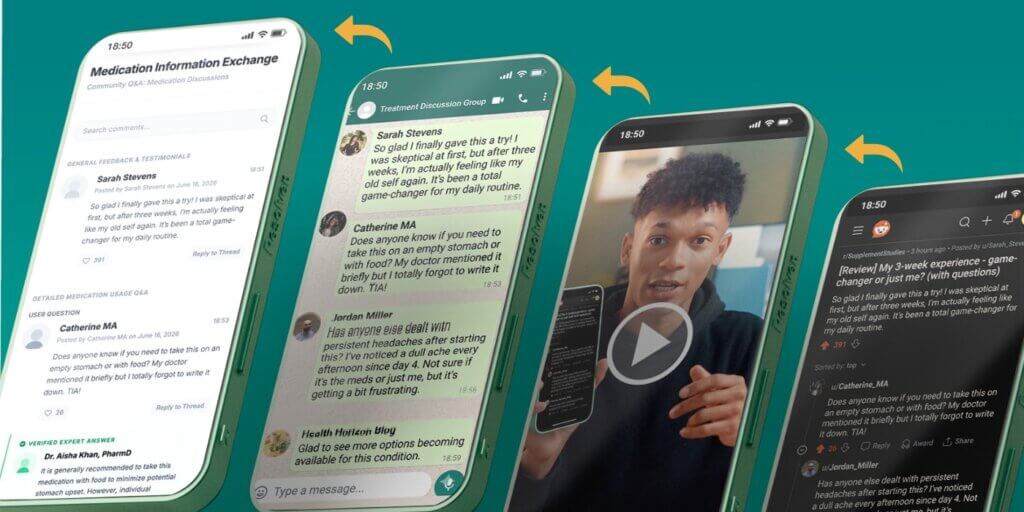
Conversations about treatments rarely stay on a single platform. Discussions often move between communities, messaging apps, video content, and social channels before reaching a brand-owned property.
2. What happens when the conversation moves beyond your brand page?
Today’s channel mix creates different visibility challenges across different platforms. Monitoring processes built for one environment don’t automatically transfer to another. A workflow built for public social networks may not account for messaging apps, creator content, podcasts, or employee activity on professional networks. Teams often assume they’re covering a channel because they’re monitoring the platform, when the real gap sits in how people are using it.
Sometimes the issue is format. Important context can appear in video, replies, or nested discussions that traditional workflows weren’t designed to review. Sometimes it’s ownership. Conversations may take place in channels you influence but don’t control, creating different monitoring and escalation considerations.
The result is coverage gaps in places that don’t look like gaps until something surfaces that the current process wasn’t designed to catch.
 |
Understanding where those gaps exist — and what each channel actually requires — is the first step toward closing them. Read our guide to the 6 Social Media Monitoring Gaps That Create Pharma Compliance Risk. |
3. Do you understand where your regulatory responsibilities begin?
Closing those gaps also raises a question most teams encounter quickly: what are you actually required to do when monitoring goes beyond the channels you own? Broadening visibility and engagement without burying your PV team in regulatory alerts starts with understanding where your responsibilities begin and how they differ between owned channels and wider social listening. Not every digital conversation creates the same responsibility. That’s where a lot of the confusion comes from.
Think of it as the difference between managing your own house and observing what’s happening in the neighborhood. You’re expected to know what’s happening in your own house. You’re not expected to watch every house on the street, but if you’re out walking the neighborhood and spot something important, you still need to know what to do.
 |
Owned pages: If it’s your brand page, your paid campaign, a sponsored DOL post, or another digital space your organization controls, you’re responsible for what’s happening there. Under ICH E2D(R1), the reporting clock starts when the information is posted, not when someone on your team eventually sees it. Digital platforms under the responsibility of the Marketing Authorization Holder (MAH) should be regularly screened, which means a business-hours-only moderation process may not be enough. |
 |
Wider social listening: When you’re monitoring public forums, Reddit communities, news sites, or other third-party spaces, you’re there to understand what’s happening, not to police the internet. You’re not expected to find every potential adverse event that’s out there. But if a human reviewer identifies one while carrying out social listening, that’s where your reporting responsibilities begin. |
That’s also why process matters. The guidance expects you to be able to show how potential adverse events are identified, reviewed, and escalated. This is where I see a lot of teams become more cautious than they need to be. Without a documented, audit-ready process, it’s often easier to narrow searches or avoid certain channels altogether. The problem is that those conversations don’t disappear. You just lose visibility into patient sentiment, competitor activity, and emerging issues until they reach you somewhere else.
An audit-ready, human-in-the-loop process changes that. It gives teams the confidence to broaden their social listening while showing exactly how potential adverse events were identified, assessed, and escalated. “We’ll report it if we see it” is no longer enough. You need to be able to show how that process works.
Build a monitoring process for modern pharma
I think the key, if you’re looking to broaden your social listening, is understanding that not every digital conversation creates the same responsibility. Given evolving FDA and EMA expectations, the process you need for your owned channels isn’t the same as the one you need for wider social listening. That’s become even more important as brands expand into new channels and create more opportunities for patients and healthcare professionals to engage.
Despite these changes, the opportunity remains the same. Wider social listening still provides valuable patient insights, competitor intelligence, and early visibility into emerging issues. The regulations have evolved, but the value of wider social listening for pharma brands hasn’t. If anything, the need for it has only grown. With the right process in place, teams can confidently broaden their monitoring across more channels, benefit from richer insights, and be ready to demonstrate how potential adverse events were identified and managed.
About the author: Emma Durant is a Strategic Client Partner in Resolver’s Corporate Risk Division, where she supports pharmaceutical marketing, pharmacovigilance, and agency teams to build compliant risk monitoring, social moderation, and adverse event detection programs.
 |
Learn how leading pharma teams are adapting to new channels, changing regulatory expectations, and modern social listening to drive confident, compliant engagement. Download our free ebook: More Channels. More Signals. More AI. How Pharma Teams Engage Confidently |