Top 8 Enterprise Risk Management Tools in 2026
Compare top enterprise risk management (ERM) tools built to improve risk visibility, reporting, automation, and resilience in 2026.


Enterprise risk management (ERM) is no longer confined to static risk registers and annual assessments. Modern organizations operate in environments where operational disruptions, regulatory pressures, cybersecurity incidents, third-party dependencies, and reputational risks are deeply interconnected.
That complexity is exposing the limitations of fragmented risk programs. Many organizations still manage risks, controls, incidents, remediation activities, and reporting across disconnected spreadsheets and siloed systems. The result is delayed decision-making, inconsistent reporting, and limited visibility into emerging enterprise risks.
Modern enterprise risk management software are designed to solve those challenges.
This guide compares eight leading enterprise risk management tools in 2026, including their strengths, limitations, and ideal use cases for enterprise organizations.
What challenges are organizations trying to solve with ERM software?
Enterprise risk management programs are becoming more operational, cross-functional, and data-driven. As organizations grow, traditional risk processes often struggle to keep pace with the volume and complexity of enterprise risk data.
Fragmented risk data creates blind spots
One of the biggest challenges organizations face is disconnected risk information spread across departments and systems.
Risk teams may manage assessments on one platform, incidents on another, controls in spreadsheets, and remediation activities via email or ticketing systems. This fragmentation makes it difficult to maintain a consistent enterprise-wide understanding of risk exposure.
Without connected visibility, organizations often struggle to:
- Identify relationships between risks and operational events
- Understand whether controls are truly effective
- Escalate emerging risks quickly
- Produce consistent reporting across business units
- Support executive and board-level decision-making
Organizations modernizing risk programs are increasingly prioritizing integrated risk management strategies that connect risks, controls, incidents, and operational workflows into a unified system.
Manual risk reporting slows decision-making
Manual processes continue to create significant operational inefficiencies for many ERM teams.
Risk assessments, issue tracking, control testing, and executive reporting often rely heavily on spreadsheets and disconnected workflows. Teams spend more time collecting information than analyzing risk trends and driving strategic decisions.
These manual processes commonly lead to:
- Delayed reporting cycles
- Inconsistent risk scoring methodologies
- Reactive executive reporting
- Limited visibility into remediation progress
- Increased administrative burden
As risk environments evolve rapidly, organizations need systems that deliver real-time operational intelligence rather than static snapshots.
Modern ERM programs call for connected operational visibility
Modern ERM programs increasingly rely on operational signals from across the business.
Incident reports, compliance findings, audit results, third-party risks, and frontline issue management all provide valuable indicators of emerging risk exposure. When those signals remain disconnected, organizations lose the ability to identify patterns before risks escalate.
Connected ERM software help organizations:
- Improve cross-functional visibility
- Surface operational risks faster
- Track interconnected issues and controls
- Strengthen organizational accountability
- Support operational resilience initiatives
This shift is driving organizations to reevaluate what enterprise risk management tools should actually deliver.
Discover Resolver's solutions.
The top enterprise risk management tools in 2026
Different ERM software solve different operational challenges. Some prioritize ecosystem integration, while others focus on workflow flexibility, operational visibility, or compliance management.
When reviewing the top enterprise risk management software vendors, we evaluated each platform based on its ability to support current ERM program and scale with future needs. Key criteria included connected risk visibility, workflow automation, reporting and analytics, configurability, integrations, usability, and support for increasingly complex enterprise risk programs.
Here are eight leading enterprise risk management tools organizations are evaluating in 2026:
1. Resolver
Best for: Organizations seeking connected enterprise risk visibility across risks, controls, incidents, issues, and operations.
Resolver differentiates itself through a connected enterprise risk management approach that links operational risk data across the organization. Instead of managing risks, controls, incidents, and remediation activities separately, Resolver connects them within a unified data model to improve visibility and decision-making.
Key strengths include:
- Connected risk, issue, and control relationships
- Operational risk visibility
- Cross-functional reporting
- No-code workflow flexibility
- Executive dashboards and reporting
- Embedded AI capabilities grounded in connected enterprise data
- Real-time operational insights
Resolver’s AI capabilities are particularly effective because they operate on connected, structured enterprise risk data. This improves consistency, reduces manual effort, and supports more accurate outputs for activities like control mapping and gap analysis.
Organizations also benefit from the flexibility that allows risk teams to adapt workflows and governance structures without relying heavily on IT resources.
Potential limitations: Organizations with highly customized legacy governance processes may require phased rollout strategies to modernize workflows effectively.
Pricing: Pricing depends on the organization’s size, needs, and customizations.
2. Archer
Best for: Large enterprises requiring broad governance and compliance capabilities.
Archer (formerly known as RSA Archer) has long been a recognized enterprise GRC platform with extensive governance functionality and broad customization options.
Key strengths:
- Mature enterprise feature set
- Broad governance coverage
- Extensive module ecosystem
- Strong enterprise scalability
Limitations:
- Complex implementation processes
- Heavy IT dependency
- Longer time to value
- Administrative complexity for business users
- Significant customization requirements
- Resource-intensive to maintain over time.
Pricing: Contact the vendor for pricing.
3. Protecht
Best for: Mid-sized organizations seeking risk-focused usability.
Protecht is often viewed as a more approachable ERM software for organizations prioritizing ease of adoption.
Key strengths:
- Easier onboarding
- Risk-centric workflows
- User-friendly design
- Faster adoption curve
Limitations:
- Less enterprise breadth for highly complex environments
- Limited large-scale ecosystem integrations
- Fewer advanced customization capabilities
- Additional configuration may be needed for enterprise-scale reporting
Pricing: Custom pricing available, contact the vendor for details.
4. ServiceNow GRC
Best for: Organizations already heavily invested in the ServiceNow ecosystem.
ServiceNow Governance, Risk, and Compliance (GRC) extends governance and risk workflows across the broader ServiceNow platform.
Key strengths:
- Strong workflow automation
- Enterprise ecosystem integration
- IT service management alignment
- Scalable platform infrastructure
Limitations:
- Not inherently risk-first
- Operational risk visibility may require customization
- Administrative complexity
- Greater emphasis on IT-centric workflows
Organizations that focus heavily on operational risk management may require additional configuration to align workflows with broader ERM objectives.
Pricing: Contact the vendor for pricing.
5. LogicGate
Best for: Organizations prioritizing workflow flexibility and faster deployment.
LogicGate is known for flexible workflow configuration and a modern user experience.
Key strengths:
- Workflow adaptability
- Faster deployment potential
- Modern interface
- Strong configurability
Limitations:
- Less enterprise depth for highly mature ERM environments
- Reporting scalability challenges
- Lighter operational risk capabilities
- May require additional tooling for complex governance programs
Pricing: Contact the vendor for pricing.
6. Riskonnect
Best for: Organizations focused on operational risk and incident management.
Riskonnect offers high operational risk and claims-related functionality for enterprise risk teams.
Key strengths:
- Operational risk focus
- Risk event tracking
- Incident management capabilities
- Strong insurance industry alignment
Limitations:
- Broader user experience limitations
- Cross-functional reporting fragmentation
- Interface complexity
- Variability between modules
Pricing: Contact the vendor for pricing.
7. MetricStream
Best for: Highly regulated enterprises with mature GRC programs.
MetricStream offers broad governance, compliance, and audit functionality designed for large enterprise environments.
Key strengths:
- Enterprise-grade scalability
- Broad regulatory support
- Integrated audit and compliance functionality
Limitations:
- User experience can feel cumbersome
- Complex onboarding for distributed teams
- Steeper learning curve for frontline users
- Reporting administration may require specialized expertise
Pricing: Contact the vendor for pricing.
8. Optro
Best for: Organizations with audit-driven governance programs.
Optro (formerly known as AuditBoard) is widely recognized for its audit and controls management functionality.
Key strengths:
- Strong audit integration
- Controls management capabilities
- Compliance workflow support
- User-friendly reporting
Limitations:
- ERM functionality may feel secondary to audit workflows
- Less operational risk depth
- Limited frontline operational intelligence
- Additional customization may be required for enterprise-wide risk relationship mapping
Pricing: Custom pricing available, contact the vendor for details.
How do the leading ERM software compare?
|
Platform |
Best for |
Strengths |
Limitations |
|
Resolver |
Connected enterprise risk visibility and operational intelligence |
Connected data model, operational visibility, no-code flexibility, embedded AI, cross-functional reporting |
Organizations with highly customized legacy governance processes may require phased modernization approaches; larger governance transformations may benefit from staged rollout planning |
|
RSA Archer |
Large enterprises with complex governance requirements |
Broad governance ecosystem, mature enterprise functionality |
Heavy IT dependency; long implementation timelines; administrative complexity for business users |
|
Protecht |
Mid-sized organizations seeking ease of adoption |
User-friendly workflows, faster onboarding |
Less enterprise breadth; limited large-scale integrations; fewer advanced customization capabilities |
|
ServiceNow GRC |
Organizations deeply invested in the ServiceNow ecosystem |
Workflow automation, enterprise integrations |
Not inherently risk-first; operational risk visibility often requires customization; IT-centric workflow orientation |
|
LogicGate |
Flexible workflow management |
Modern interface, adaptable workflows |
Lighter enterprise depth; reporting scalability limitations; less mature operational risk relationship mapping |
|
Riskonnect |
Operational risk and insurance-focused programs |
Risk event tracking, operational risk workflows |
Broader UX limitations; fragmented cross-functional reporting; interface complexity across modules |
|
MetricStream |
Highly regulated enterprise GRC programs |
Strong compliance capabilities, enterprise scalability |
Complex user experience; slower onboarding for distributed teams; reporting administration may require specialized expertise |
|
Optro |
Audit-centric governance programs |
Strong audit integration and controls management |
ERM capabilities may feel secondary to audit workflows; less operational risk depth; limited frontline operational intelligence |
No ERM software is universally ideal for every organization. Some platforms prioritize breadth of governance, while others focus on workflow flexibility, audit alignment, or operational risk management.
Organizations with growing operational complexity often benefit most from platforms that connect risks, controls, incidents, remediation activities, and business operations into a unified view. That connected visibility becomes increasingly important as organizations scale reporting requirements, resilience initiatives, and AI-driven workflows.
Read: Top Operational Risk Management Software Reviewed for 2026
What should enterprise risk management tools include?
Not all ERM software are designed the same way. Some focus heavily on compliance workflows, while others prioritize audit management or IT governance. Organizations evaluating enterprise risk management software vendors should focus on platforms that support both operational visibility and long-term scalability.
Centralized enterprise-wide risk visibility
Strong ERM platforms provide a connected view of enterprise risk data across departments and workflows.
This includes:
- Shared risk taxonomies
- Centralized reporting
- Connected risk relationships
- Cross-functional dashboards
- Unified operational visibility
The ability to connect risks, controls, incidents, issues, and remediation activities in a single system helps organizations understand how risks affect broader business operations.
Organizations evaluating vendors often prioritize enterprise risk management software that supports enterprise-wide visibility and consistent reporting.
Automation for assessments and remediation workflows
Manual workflows slow down risk programs and create reporting inconsistencies.
Modern ERM software should automate:
- Risk assessments
- Issue management
- Control tracking
- Escalation workflows
- Remediation activities
- Notifications and approvals
Automation helps organizations reduce administrative overhead while improving consistency across the risk lifecycle.
Flexible workflows that evolve with the business
Enterprise risk programs rarely stay static.
As organizations grow, expand into new markets, or face changing regulatory requirements, their risk frameworks and workflows evolve as well.
Flexible ERM platforms should support:
- No-code configurability
- Adaptable taxonomies
- Workflow customization
- Scalable governance structures
- Reduced IT dependency
This flexibility allows organizations to mature their programs without rebuilding systems from scratch.
AI capabilities built on connected risk data
AI is becoming an increasingly important component of modern ERM software. However, AI effectiveness depends heavily on the quality and structure of the underlying data.
Disconnected or inconsistent risk data limits the accuracy of AI-generated outputs. Connected data models improve AI performance by providing structured relationships between risks, controls, incidents, frameworks, and remediation activities.
Purpose-built AI capabilities in ERM platforms can support:
- Regulatory summarization
- Control mapping
- Gap analysis
- Framework alignment
- Workflow recommendations
- Reduced duplicate work
The most effective AI implementations are transparent, auditable, and designed to keep humans in control of decision-making processes.
Organizations exploring AI in risk management and compliance are increasingly prioritizing platforms with connected data foundations that improve AI accuracy and operational reliability.
 |
Enterprise Risk Management Software for BanksLearn how banks can use connected ERM software to improve risk visibility, streamline workflows, support reporting, and strengthen resilience. |
What you should expect from your chosen ERM software?
No enterprise risk management platform fits every organization equally well. The right solution depends on operational complexity, reporting requirements, implementation resources, and long-term program maturity goals.
Resolver stands out for organizations prioritizing:
- Connected enterprise risk visibility
- Operational intelligence
- Embedded AI grounded in structured data
- Cross-functional collaboration
- Flexible no-code workflows
Other vendors may offer broader governance ecosystems, stronger audit alignment, or tighter IT integrations, depending on organizational priorities.
Organizations comparing enterprise risk management software vendors often benefit from reviewing the best enterprise risk management software evaluation criteria before finalizing platform decisions.
How should organizations choose the right enterprise risk management software?
Selecting an ERM software is not just a technology decision. It is a long-term operational strategy decision that affects governance, reporting, resilience, and organizational collaboration.
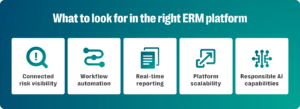
Does the platform support connected risk visibility?
Disconnected workflows create reporting gaps and slow response times.
Organizations should evaluate whether the platform connects:
- Risks
- Controls
- Incidents
- Issues
- Remediation activities
- Operational data
Connected visibility improves both executive reporting and operational responsiveness.
Can business users manage workflows without IT bottlenecks?
ERM programs evolve continuously. Organizations benefit from platforms that allow risk teams to adapt workflows without relying entirely on technical development resources.
Important capabilities include:
- No-code configuration
- Flexible reporting structures
- Workflow customization
- Scalable governance models
This flexibility improves adoption and reduces long-term administrative burden.
Are there real-time dashboards and executive reporting?
Executive teams increasingly expect real-time risk insights instead of quarterly static reports.
Modern ERM platforms should support:
- Board-ready dashboards
- Operational reporting
- Trend analysis
- Risk heat maps
- Scenario visibility
- KPI and KRI tracking
Organizations that improve executive reporting capabilities often focus on risk management reporting strategies to enhance visibility and decision-making across the enterprise.
Will the platform scale as the ERM program matures?
Organizations should consider future operational complexity, not just immediate requirements.
Scalable ERM software should support:
- Multi-framework compliance
- Global reporting
- Enterprise resilience initiatives
- Cross-functional governance
- Expanding operational workflows
Organizations scaling risk programs often focus on developing mature ERM programs that demonstrate measurable business value.
Does the AI functionality improve operational efficiency responsibly?
AI capabilities should improve efficiency without reducing transparency or accountability.
Organizations should prioritize AI functionality that:
- Operates on connected data
- Produces auditable outputs
- Supports human oversight
- Reduces repetitive manual work
- Improves consistency across workflows
Connected data models remain one of the most important foundations for reliable AI performance in ERM environments.
What implementation best practices improve ERM success?
Successful ERM implementations depend as much on operational alignment as technology selection.
Start with operational pain points
Many organizations approach ERM implementations as compliance exercises instead of operational improvement initiatives.
The strongest implementations focus first on solving problems like:
- Fragmented reporting
- Manual workflows
- Delayed risk escalation
- Limited executive visibility
- Disconnected operational intelligence
This approach improves adoption and demonstrates value more quickly.
Build cross-functional ownership early
Risk management is no longer isolated within compliance or audit teams.
Modern ERM programs require participation from:
- Operations
- Security
- Compliance
- Audit
- IT
- Business leadership
Cross-functional collaboration improves visibility, accountability, and organizational resilience.
Organizations building collaborative risk cultures often explore the benefits of risk management software that supports enterprise-wide engagement and visibility.
Prioritize data consistency and taxonomy alignment
Consistent data structures improve reporting accuracy, workflow efficiency, and AI effectiveness.
Organizations should standardize:
- Risk taxonomies
- Control libraries
- Reporting structures
- Incident classifications
- Governance hierarchies
Connected, reliable data significantly improves operational intelligence and reduces duplicate work across teams.
Focus on phased maturity instead of massive transformation
Large-scale governance transformations can create unnecessary operational disruption.
Many organizations achieve better results through phased modernization strategies that:
- Deliver faster time to value
- Improve adoption
- Reduce implementation risk
- Allow workflows to evolve gradually
This approach is especially important for organizations modernizing legacy governance environments.
How organizations are using Resolver to modernize enterprise risk management?
How Grow Financial embedded risk management into enterprise decision-making
Grow Financial Credit Union recognized that its existing enterprise risk management process was becoming too reactive and operationally limited. Following increased regulatory pressure from the National Credit Union Administration (NCUA), the organization wanted to move beyond a “check-the-box” approach to risk management and build a program that could actively support business decision-making.
Its previous system — essentially an advanced spreadsheet-based process — lacked the visibility, scalability, and consistency needed to support 30 departments across a growing organization.
The risk team needed to:
- Improve visibility into enterprise-wide risks
- Standardize risk assessments across departments
- Strengthen frontline engagement
- Reduce manual administrative work
- Better align risk management with strategic objectives
Resolver helped Grow Financial centralize its risk register and create a more consistent risk assessment framework across the organization. Teams gained better visibility into risks, controls, remediation activities, and residual risk trends while improving accountability between departments.
The organization also benefited from stronger frontline engagement, enabling departments to participate directly in risk assessments and ongoing risk monitoring rather than relying entirely on the centralized risk team.
By connecting operational workflows with enterprise risk visibility, Grow Financial improved transparency, standardized reporting, and more directly embedded risk management into day-to-day decision-making.
How SC Ventures simplified and automated risk and compliance workflows
SC Ventures, the innovation and ventures division of Standard Chartered Bank, needed a governance, risk, and compliance platform to reduce operational complexity and enable scalable growth across its fintech ventures.
One of the first implementations involved Autumn, a fintech startup that was managing risk registers, control testing, approvals, and reporting manually through spreadsheets and disconnected processes. These workflows created challenges with version control, audit visibility, reporting consistency, and administrative efficiency.
SC Ventures wanted a platform that could:
- Automate manual GRC processes
- Improve operational visibility
- Simplify reporting and approvals
- Support scalable governance workflows
- Remain flexible for fast-moving fintech environments
Resolver was selected because of its user-friendly interface, workflow flexibility, and API integration capabilities. The platform allowed teams to automate risk assessments, reporting, control tracking, and workflow management while adapting processes to operational needs.
The implementation helped reduce manual administrative work, improve reporting consistency, and create a more scalable governance framework that could support future ventures.
The project also demonstrated how connected, user-friendly GRC workflows can help organizations modernize governance without creating unnecessary operational friction.
Frequently Asked Questions About Enterprise Risk Management Tools
What challenges do enterprise risk management tools help solve?
ERM tools help reduce fragmented risk data, manual reporting, inconsistent assessments, and limited visibility across risks, controls, incidents, and remediation activities.
What should ideal enterprise risk management software include?
Strong ERM software should provide centralized risk visibility, automated workflows, flexible configuration, real-time reporting, scalable governance, and connected risk data.
How do enterprise risk management tools compare?
ERM platforms vary in focus. Some prioritize governance and compliance, while others specialize in workflow flexibility, audit management, operational risk, or connected enterprise risk visibility.
How can ERM software improve risk reporting?
ERM software can provide real-time dashboards, risk heat maps, trend analysis, KPI and KRI tracking, and more consistent executive and board reporting.
How is AI used in enterprise risk management software?
AI can support control mapping, gap analysis, regulatory summarization, framework alignment, and workflow recommendations while reducing repetitive manual work.
Can ERM software replace spreadsheets?
ERM software can reduce reliance on spreadsheets by centralizing risk information, automating workflows, standardizing assessments, and improving reporting consistency.
How should organizations choose the right ERM software?
Organizations should consider connected risk visibility, workflow flexibility, reporting capabilities, scalability, integrations, AI functionality, and the resources required to manage the platform.
What are ERM software implementation best practices?
Start with key operational pain points, involve cross-functional teams, standardize risk data, and use a phased implementation approach to improve adoption and reduce implementation risk.
Why connected ERM platforms are becoming essential for resilience?
Enterprise risk management is becoming increasingly operational, interconnected, and data-driven.
Organizations no longer need platforms that simply document risks. They need systems that connect operational signals, improve visibility, support executive decision-making, and help teams respond faster to emerging challenges.
Connected ERM software provide organizations with:
- Better operational visibility
- Faster reporting cycles
- Improved collaboration
- Stronger resilience planning
- More effective AI-driven workflows
- Scalable governance structures
As enterprise environments continue evolving, organizations that unify risk, operational intelligence, and reporting will be better positioned to make proactive, informed decisions.
See how Resolver connects enterprise risk, operational visibility, and AI-driven workflows in one platform through the Risk Management Showcase.