Enterprise Risk Management Software for Banks: Modernizing Risk Programs
A practical look at how banks can improve risk visibility, streamline workflows, and strengthen resilience with connected ERM software.


Banks operate in a complex risk environment. This continues to intensify as regulatory expectations shift, operational resilience becomes a strategic priority, and financial institutions face growing pressure to improve visibility into interconnected risks.
At the same time, many banks still manage enterprise risk through disconnected systems.
This challenge is especially significant for mid-market and regional banks. Lean risk teams must manage expanding regulatory obligations while balancing operational efficiency, governance expectations, cybersecurity concerns, fraud risks, third-party oversight, and business continuity planning.
Modern enterprise risk management software for banks helps them to move beyond fragmented processes by connecting operational risk data, automating workflows, improving reporting visibility, and supporting more proactive decision-making across the organization.
Discover Resolver's solutions.
Why do banks need enterprise risk management software
Enterprise risk management software helps banks centralize risk oversight, gain real-time visibility into emerging issues, streamline compliance workflows, and respond to regulations in a timely and considerate manner.
Without this software, issues related to operations, compliance, reputation, and customer trust can spread rapidly across the organization, leading to knowledge gaps and misalignment due to growing regulatory pressure. In addition, for institutions operating across multiple jurisdictions, managing compliance becomes even more complex due to overlapping and sometimes conflicting regional regulations.
At any bank, a single operational incident can impact:
- Regulatory reporting
- Customer experience
- Fraud exposure
- Third-party oversight
- Financial performance
- Business continuity
As banking environments become more digital and interconnected, traditional risk management approaches often struggle to provide the visibility organizations need.
Many institutions still rely on:
- Spreadsheets
- Email-based approvals
- Manual assessments
- Siloed reporting systems
- Department-specific workflows
These disconnected processes create operational blind spots, making it harder to identify emerging risks early and respond consistently across the organization.
Modern enterprise risk management software solutions help banks centralize risk visibility and improve cross-functional collaboration across operational, compliance, and governance workflows.
What challenges do banks face in managing enterprise risk
Banking organizations face growing pressure to modernize risk programs while maintaining operational efficiency and regulatory readiness.
Fragmented risk data creates visibility gaps
Risk data is often distributed across multiple systems and departments.
Operational risk events, compliance issues, vendor risks, cybersecurity findings, audit observations, and remediation activities may all be managed separately. This fragmentation makes it difficult for leadership teams to understand how risks connect across the enterprise.
Without connected visibility, banks may struggle to:
- Identify risk interdependencies
- Track control effectiveness
- Escalate operational issues quickly
- Produce consistent enterprise reporting
- Maintain clear accountability
As programs mature, many institutions recognize the limitations of siloed risk management approaches.
Manual workflows slow down banking risk programs
Manual processes remain a major operational challenge for risk teams.
Many banks still rely heavily on spreadsheets and email-based workflows for:
- Risk assessments
- Control testing
- Issue management
- Remediation tracking
- Regulatory reporting
These manual processes consume significant time and create inconsistencies between departments and business units.
Operationally, this often leads to:
- Delayed reporting cycles
- Duplicate work
- Limited audit visibility
- Difficulty standardizing assessments
- Increased administrative burden
For mid-market banks with leaner teams, these inefficiencies can quickly become difficult to scale.
Organizations working to modernize governance processes often encounter common ERM program implementation challenges related to visibility, standardization, and operational coordination.
Frontline operational visibility matters in banking
Banks rely heavily on frontline teams to surface operational risks early.
Branch operations, fraud teams, call centres, lending departments, payments operations, and customer support teams all generate valuable operational risk signals. However, disconnected reporting systems often prevent those insights from reaching enterprise risk teams quickly enough.
This creates delayed visibility into:
- Fraud trends
- Operational disruptions
- Process breakdowns
- Third-party issues
- Customer-impacting incidents
- Emerging compliance concerns
Enterprise risk management software for banks helps connect frontline operational data with enterprise-wide governance workflows to improve responsiveness and accountability.
Regulatory expectations increase complexity
Banks must continuously reassess risks, controls, and governance processes as guidance evolves. Regulatory expectations continue to expand across areas such as:
- Operational resilience
- Third-party risk management
- Cybersecurity governance
- Consumer protection
- Compliance oversight
- Incident reporting
For many mid-market institutions, maintaining that level of continuous oversight can strain already limited resources. Large enterprise GRC platforms are often too complex, resource-intensive, or IT-dependent for smaller banking organizations to manage efficiently.
This has increased demand for practical ERM platforms that balance enterprise capabilities with operational usability.
How can ERM software improve risk management for banks
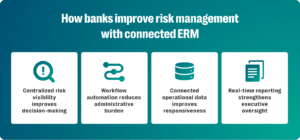
Modern ERM software helps banks improve visibility, consistency, and operational coordination across the enterprise.
Instead of managing risks, controls, incidents, and remediation activities separately, connected ERM platforms bring those workflows together within a centralized environment.
Centralized risk visibility improves decision-making
Connected risk visibility allows banks to understand how operational events, issues, controls, and business processes relate to one another.
This improves:
- Executive reporting
- Risk prioritization
- Control oversight
- Cross-functional coordination
- Enterprise accountability
Leadership teams gain more accurate, real-time insights into enterprise risk exposure instead of relying on static reporting cycles.
Connected operational data improves responsiveness
Banks generate enormous amounts of operational risk data across departments every day.
Connected ERM systems help organizations:
- Surface operational issues faster
- Identify emerging risk trends
- Improve incident response coordination
- Strengthen frontline engagement
- Improve organizational accountability
This operational visibility becomes especially important during periods of regulatory change or operational disruption. Financial institutions looking to strengthen these capabilities can review leading operational risk management software for connecting risk events, controls, assessments, remediation, and reporting.
Workflow automation reduces administrative burden
Automation helps banks reduce manual effort while improving consistency across risk workflows.
Modern ERM platforms can automate:
- Risk assessments
- Notifications and escalations
- Remediation tracking
- Approval workflows
- Control testing
- Reporting processes
This allows risk teams to spend less time managing spreadsheets and more time analyzing operational trends and improving resilience strategies.
Real-time reporting strengthens executive oversight
Executive and board reporting remains one of the most resource-intensive aspects of many ERM programs.
Modern platforms improve reporting by providing:
- Real-time dashboards
- Connected risk insights
- Standardized reporting structures
- Trend analysis
- Centralized documentation
This helps leadership teams make faster, more informed decisions while improving transparency across the organization.
 |
Read about the Top Enterprise Risk Management Tools in 2026
Explore the leading ERM software which will simplify risk management with automation, connected workflows, dashboards, and reporting, helping teams save time, improve risk visibility, and make better informed decisions. |
What features should banks look for in ERM software
Not all enterprise risk management platforms are equally suited for banking environments. Financial institutions should prioritize ERM software solutions that improve operational visibility without creating unnecessary administrative complexity.
Connected enterprise risk visibility
Banks need platforms that connect:
- Risks
- Controls
- Operational incidents
- Issues
- Remediation activities
- Business operations
Connected data models improve visibility into how risks impact broader organizational processes and decision-making.
Ease of implementation and usability
Many banking organizations lack the resources required to support highly technical, IT-dependent implementations.
Mid-market institutions especially benefit from platforms that offer:
- Faster deployment timelines
- User-friendly interfaces
- Reduced administrative complexity
- Flexible workflow configuration
- Minimal IT dependency
Ease of adoption is critical for long-term program success.
Automation and workflow management
Strong ERM platforms should support automation across key governance activities, including:
- Risk assessments
- Issue management
- Remediation tracking
- Escalation workflows
- Reporting processes
Automation reduces duplicate work and improves consistency across departments.
Reporting and executive dashboards
Banks require reporting capabilities that support both operational teams and executive leadership.
Important capabilities include:
- Real-time dashboards
- Board-ready reporting
- Risk trend analysis
- Centralized reporting structures
- KPI and KRI tracking
Organizations strengthening executive oversight often prioritize banking risk management and compliance software that improves enterprise-wide reporting visibility.
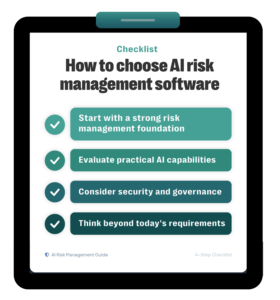
AI capabilities built on connected risk data
AI is becoming increasingly valuable in banking ERM programs, but effectiveness depends heavily on the quality of the underlying data.
Purpose-built AI capabilities can support:
- Regulatory summarization
- Control mapping
- Gap analysis
- Requirement alignment
- Reduced duplicate work
However, AI outputs are only as reliable as the data structure supporting them. Connected enterprise risk data improves consistency, transparency, and auditability.
The strongest platforms approach AI intentionally — focusing on operational efficiency and human oversight instead of automation for its own sake.
 |
Top AI Risk Management Software to Consider in 2026
Review leading AI risk management software for improving assessments, identifying risk and control gaps, reducing manual work, monitoring risk, and supporting better decisions. |
What are the benefits of enterprise risk management software for banks
Banks adopting modern ERM software often improve both operational efficiency and enterprise-wide visibility.
Key benefits include:
- Faster and more consistent reporting
- Improved cross-functional collaboration
- Better visibility into operational risk trends
- Reduced manual administrative work
- More proactive issue management
- Improved executive decision-making
- Stronger regulatory readiness
- Better frontline engagement
- Improved resilience planning
Connected ERM platforms also help organizations move beyond static compliance exercises toward more operational, intelligence-driven risk management strategies.
Financial institutions exploring modernization initiatives often benefit from hearing practical perspectives on ERM in banking and financial services.
 |
Top Governance, Risk, and Compliance Platforms to Consider in 2026
Review leading GRC software for managing risk, compliance, audits, controls, policies, and reporting across a more connected governance program. |
Why Resolver Is a Strong Enterprise Risk Management Software for Banks
Resolver is designed to help organizations connect enterprise risk visibility with operational workflows, frontline engagement, and executive decision-making.
For banks, this connected approach is particularly valuable because operational risks, controls, incidents, and remediation activities are often deeply interconnected.
Connected enterprise risk management improves visibility
Resolver connects:
- Risks
- Controls
- Risk events
- Issues
- Business operations
- Remediation workflows
This unified data model improves visibility into enterprise-wide exposure while helping organizations identify operational interdependencies more effectively.
Instead of managing disconnected governance activities separately, banks gain a more holistic understanding of enterprise risk.
Operational risk visibility strengthens responsiveness
Resolver’s integrated risk event and issue management capabilities help organizations surface operational signals from frontline teams faster.
This improves:
- Fraud visibility
- Incident escalation
- Operational responsiveness
- Cross-functional coordination
- Organizational accountability
For banks managing distributed operations and multiple business units, this visibility can significantly improve issue response and reporting consistency.
No-code flexibility reduces IT dependency
Risk programs evolve continuously as regulatory expectations, operational structures, and governance requirements change.
Resolver’s no-code flexibility allows teams to adapt without requiring extensive IT involvement. This includes:
- Workflows
- Taxonomies
- Reporting structures
- Governance hierarchies
- Assessment methodologies
This flexibility is especially valuable for mid-market banks seeking scalable governance without requiring highly resource-intensive implementations.
Embedded AI supports more efficient risk workflows
Resolver’s AI capabilities are designed as an embedded operational layer built on connected, structured enterprise data.
This supports use cases such as:
- Control mapping
- Control generation
- Regulatory summarization
- Framework alignment
- Gap analysis
Because the AI operates within connected risk relationships, outputs are more transparent, auditable, and operationally relevant.
Importantly, human oversight remains central to the process. AI is designed to improve efficiency and consistency — not replace governance decision-making.
How Banks Are Modernizing ERM Programs With Resolver
Bangor Savings Bank already had an established ERM program, but the organization struggled with inefficiencies stemming from spreadsheets, manual reporting processes, and disconnected workflows.
The risk team needed a more scalable way to:
- Connect risks, controls, and operational activities
- Improve collaboration with business line managers
- Reduce manual reporting effort
- Strengthen audit and compliance visibility
- Improve tracking of incidents and findings
Creating board reporting packages was highly time-consuming, while operational incidents submitted through email created visibility and tracking challenges.
Resolver helped Bangor Savings Bank centralize and streamline its ERM workflows by consolidating risks, controls, findings, incidents, and compliance activities into a single system. The organization improved reporting efficiency, simplified COSO management, and strengthened collaboration between risk owners and internal audit teams.
The bank also improved frontline accountability by allowing business line managers to participate more directly in control attestations and operational risk tracking.
By replacing disconnected spreadsheet and email-based processes with connected workflows, Bangor Savings Bank improved operational visibility, reporting consistency, and overall ERM efficiency.
Why Connected Visibility Matters for Risk Management in Banking
Banking risk environments are becoming more operational, interconnected, and fast-moving.
Traditional spreadsheet-driven processes no longer provide the visibility or responsiveness banks need to manage evolving regulatory expectations, operational disruptions, third-party risks, and enterprise-wide governance responsibilities effectively.
Modern enterprise risk management software helps financial institutions:
- Improve operational visibility
- Connect fragmented workflows
- Strengthen executive reporting
- Automate governance activities
- Improve resilience planning
- Support faster decision-making
As banking organizations continue modernizing risk programs, connected ERM platforms will play an increasingly important role in improving organizational agility, accountability, and operational resilience.
See how Resolver helps banks connect enterprise risk visibility, operational intelligence, and governance workflows in one platform through our Risk Management Showcase.