AI and Regulatory Compliance: The True Cost of Compliance Delays
Every new regulation creates a race against the clock, but most compliance teams start too late. Learn how AI is changing who keeps up and who falls behind.


Every regulatory change starts a countdown. The moment a new rule is published, the distance between “we know about this” and “we’re compliant” becomes a risk.
As AI and regulatory compliance become more tightly linked, the pressure to move from awareness to compliance faster is growing. But many teams are still tracking regulatory updates manually, so changes surface late.
They spend weeks interpreting what a new requirement means for their operations, then more weeks updating controls, policies, and documentation. By the time everything’s in place, the deadline has passed. Or worse, an auditor has already arrived.
While AI is starting to reshape regulatory compliance, most teams haven’t adjusted their processes to take advantage of it. The consequences are measurable. Fines for non-compliance have grown sharper, and regulators in financial services are signaling little tolerance for “we were working on it”. For many organizations, a delayed response to a regulatory change isn’t just an operational hiccup. It becomes a measurable risk event — one that shows up in audit findings, remediation costs, and sometimes, public enforcement actions.
AI-powered systems are changing how compliance teams respond to that pressure. They’re compressing timelines, reducing manual effort, and giving teams earlier visibility into what’s coming. But understanding why the delay problem persists and what it’s actually costing is the right place to start.
Discover Resolver's solutions.
Why compliance delays keep happening
Most compliance delays start with how regulatory change gets distributed.
The regulatory environment has shifted faster than most compliance programs have. Since 2023, financial regulators across North America and Europe have accelerated rulemaking — particularly around data privacy, AI governance, and ESG reporting. The expectation on compliance teams has changed, but the infrastructure many are working with hasn’t.
Part of that comes down to how compliance functions are structured. Ownership of regulatory change is often fragmented across departments, meaning a new requirement might get spotted by one team and acted on by another, with a significant lag in between. When there’s no centralized system connecting those two points, delays are built into the process.
The tools exist to fix this. AI-powered regulatory change management systems can monitor sources continuously, flag relevant changes automatically, and route them to the right owners without manual intervention. But adoption hasn’t kept pace with availability. Many organizations are still running compliance programs on a combination of spreadsheets, email chains, and tribal knowledge — not because better options don’t exist, but because the case for change hasn’t been made compellingly enough internally.
That gap between what’s available and what’s being used is where regulatory risk quietly accumulates
 |
How to Build an AI-Ready Compliance Program That Goes Beyond PolicyDiscover how teams across regulated industries are incorporating AI into their programs, and where most are falling short. |
The hidden costs of regulatory compliance delays
Regulatory fines are the most visible consequence of delayed compliance, but they’re rarely the most damaging one. As the relationship between AI and regulatory compliance matures, regulators are raising their expectations around how organizations monitor and respond to change. The EU’s GDPR enforcement actions averaged €2.27 million per fine in 2023, reflecting a clear shift toward larger, more punitive penalties. And financial regulators in the US and UK have shown similar appetite for significant penalties.
What’s harder to quantify is everything that follows. When a compliance gap surfaces during an audit, the impact spreads quickly. Controls need updating, documentation needs rebuilding, and leadership needs answers — all at the same time, under scrutiny.
There’s also a resourcing cost that doesn’t show up in enforcement figures. Teams pulled into reactive remediation aren’t working on the proactive compliance work that prevents the next gap. The organization pays twice: Once for the finding, and again in the opportunity cost of the response.
Reputational exposure compounds this further. For financial institutions, a public enforcement action isn’t just a financial event. It signals to regulators, clients, and counterparties that the compliance program has weaknesses. That perception is difficult, and expensive, to reverse. And in highly regulated industries, it has real commercial consequences. The cost of delayed compliance isn’t a single line item. It accumulates across functions, across time, and often surfaces long after the original delay occurred.
In many cases, part of the problem is visibility. When compliance data is fragmented across systems, it’s harder to understand where requirements are being met and where gaps still exist. One US-based bank, for example, reportedly increased compliance coverage from 75% to more than 95% after adopting automated RegTech tools that streamlined data mapping. That kind of visibility is difficult to maintain through time-consuming compliance processes alone.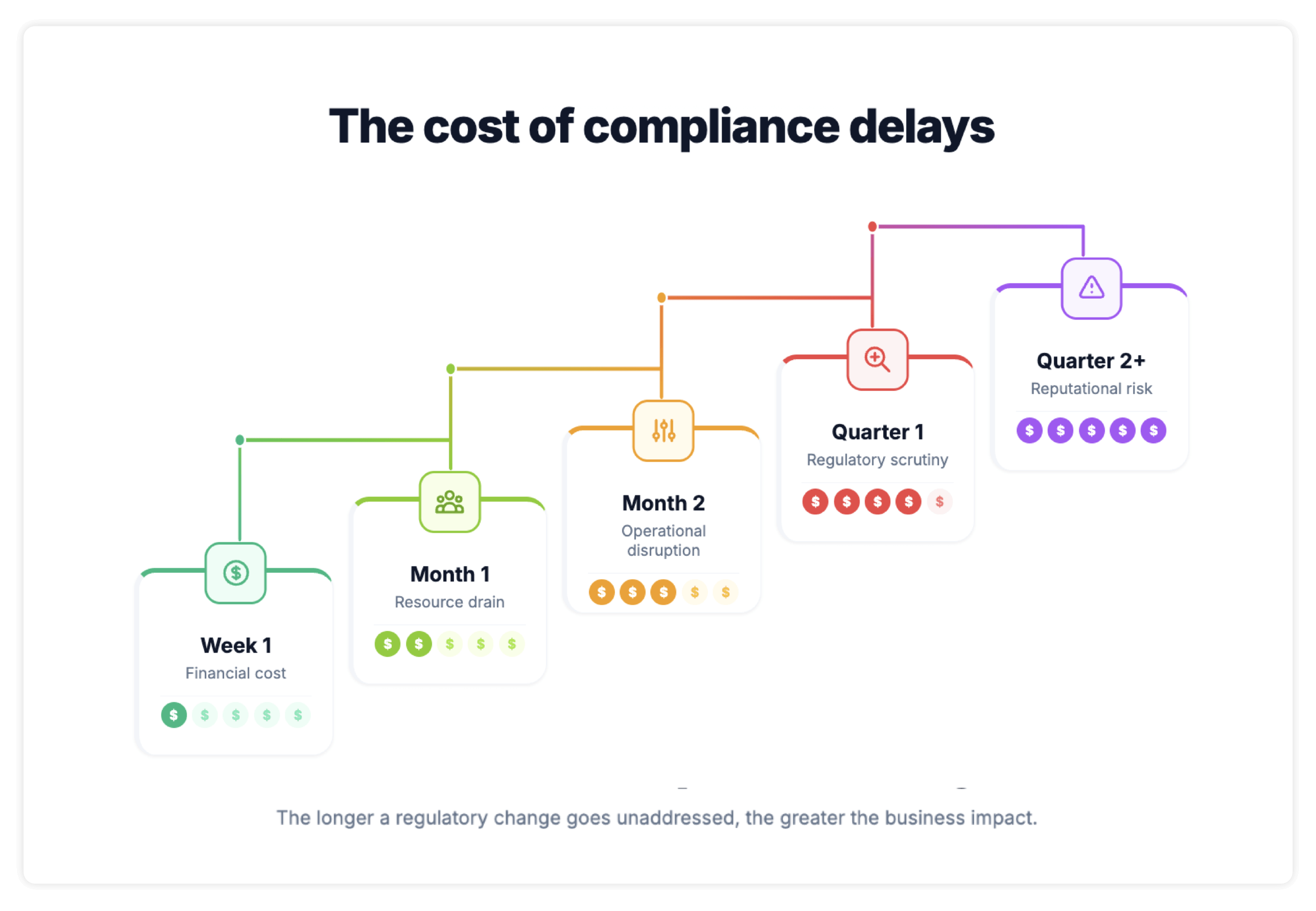
How AI improves regulatory compliance and reduces delays
Regulatory change moves faster than the processes built to manage it. AI-powered systems address that at the source, and the way they do it is worth understanding in some detail.
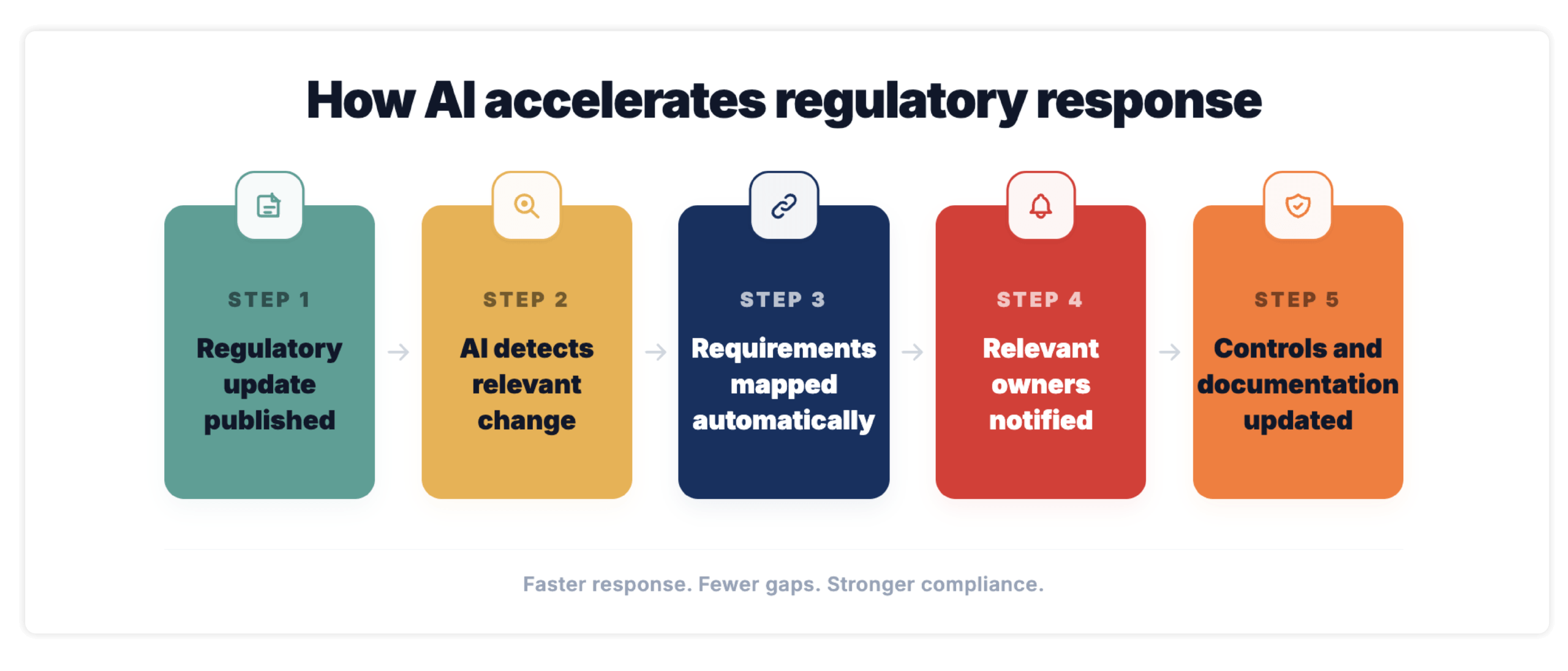
Continuous monitoring is where it starts. Most compliance teams are working from a patchwork of regulatory sources across jurisdictions and publication schedules. When an AI-powered system consolidates that monitoring automatically, a relevant change gets surfaced the moment it’s published. That immediacy matters because everything else in the compliance process depends on it — interpretation, ownership, control updates. The earlier a change is caught, the more time a team has to respond thoughtfully rather than reactively.
That response gets faster because interpretation is no longer a manual exercise. Understanding how a new rule interacts with existing controls has traditionally required significant effort. This includes reading dense regulatory text, cross-referencing existing documentation, and making judgment calls about what needs to change. When AI handles that mapping, compliance teams receive analysis rather than raw material. They’re deciding how to act on a requirement, with the groundwork already done.
Over time, that combination of earlier detection and faster interpretation changes the posture of the compliance function itself. Documentation builds continuously rather than getting assembled before an audit. When ownership gets established earlier, the program stops running on catch-up and starts running on foresight. Which is exactly what a well-integrated AI and regulatory compliance strategy is designed to produce.
 |
Watch: Operationalizing AI in GRCSee how risk and compliance teams are using AI to move faster on the work that slows them down most — without adding tools, headcount, or risk. |
What a mature compliance program looks like
Consider a mid-size regional bank managing compliance across three jurisdictions. Their regulatory footprint has grown steadily over the past two years, but their compliance team hasn’t. Before integrating AI into their regulatory compliance program, the team was spending the majority of their time monitoring sources, interpreting new requirements, and preparing documentation for audits. Proactive work kept getting pushed back.
After implementation, the picture looked different. Regulatory changes were getting surfaced automatically, with relevance assessments already attached. The team was spending less time figuring out what a new requirement meant and more time deciding how to respond to it. Audit preparation stopped being a periodic scramble and became an ongoing process.
The more significant change was structural. Because the team was operating with earlier visibility into regulatory change, they could brief senior stakeholders with confidence. Risk assessments were more current. Controls were getting updated before gaps became findings rather than after.
For compliance leaders thinking about where AI and regulatory compliance intersect in their own programs, this is the operational shift worth focusing on. The technology doesn’t remove the need for expertise — it gives that expertise more room to operate. A well-built AI and regulatory compliance strategy puts the compliance function in a position where it’s informing business decisions rather than reacting to regulatory pressure.
 Resolver’s approach to AI and regulatory compliance management
Closing the gap between regulatory change and compliance response isn’t a process problem — it’s an infrastructure problem. The teams that manage it well aren’t working harder. They’re working with better tools.
Resolver’s AI-powered Regulatory Compliance platform gives compliance teams a single place to track regulatory updates, assess their impact, and move changes through structured workflows — all with a full audit trail built in. AI-powered requirement mapping surfaces overlapping obligations automatically. Control recommendations get generated based on new requirements, reducing the manual analysis that slows teams down.
Development efforts can be streamlined through AI-assisted control generation based on new requirements or risks, accelerating updates and helping teams maintain consistent design. Every decision, review, and remediation action is documented and traceable, so audit preparation isn’t a sprint — it’s already done.
For compliance leaders managing a growing regulatory footprint, that’s the difference between a program that reacts and one that holds up.
Book a demo to see how Resolver’s AI-powered regulatory compliance management works in practice.