How to Build an AI-Ready Compliance Program That Goes Beyond Policy
As AI embeds itself across regulated industries, teams are being handed a mandate their current programs weren't built to handle. Here's what that requires, and where most programs are falling short.

For years, compliance followed a predictable cycle: new regulations, updated policies, documented controls, and periodic audits. That model assumed the systems being governed were stable. Once a control was defined and tested, its risk profile didn’t materially change until the next review cycle.
AI breaks that assumption.
An AI regulatory compliance program evolves after deployment. Models retrain, outputs shift, and in some cases decisions are made without human intervention. Risk is no longer fixed at a point in time — it moves with the system. That creates a structural problem for compliance. Frameworks built on periodic reviews and static controls can’t keep pace with systems that continuously change.
A modern system can help to address this directly. It embeds governance into the AI lifecycle, with continuous monitoring, risk-tiered oversight, and clear accountability for how models behave over time. As Ben Bradley, Senior Product Manager, GRC at Resolver, discussed at the #RISK Digital Global conference, this shift is already forcing organizations to rethink how compliance operates, not just what it documents. Most programs are still catching up. Below, we’ll outline where compliance programs break down under AI and what needs to change to make them effective.
Discover Resolver's solutions.
How AI can solve multiple problems for the compliance teams
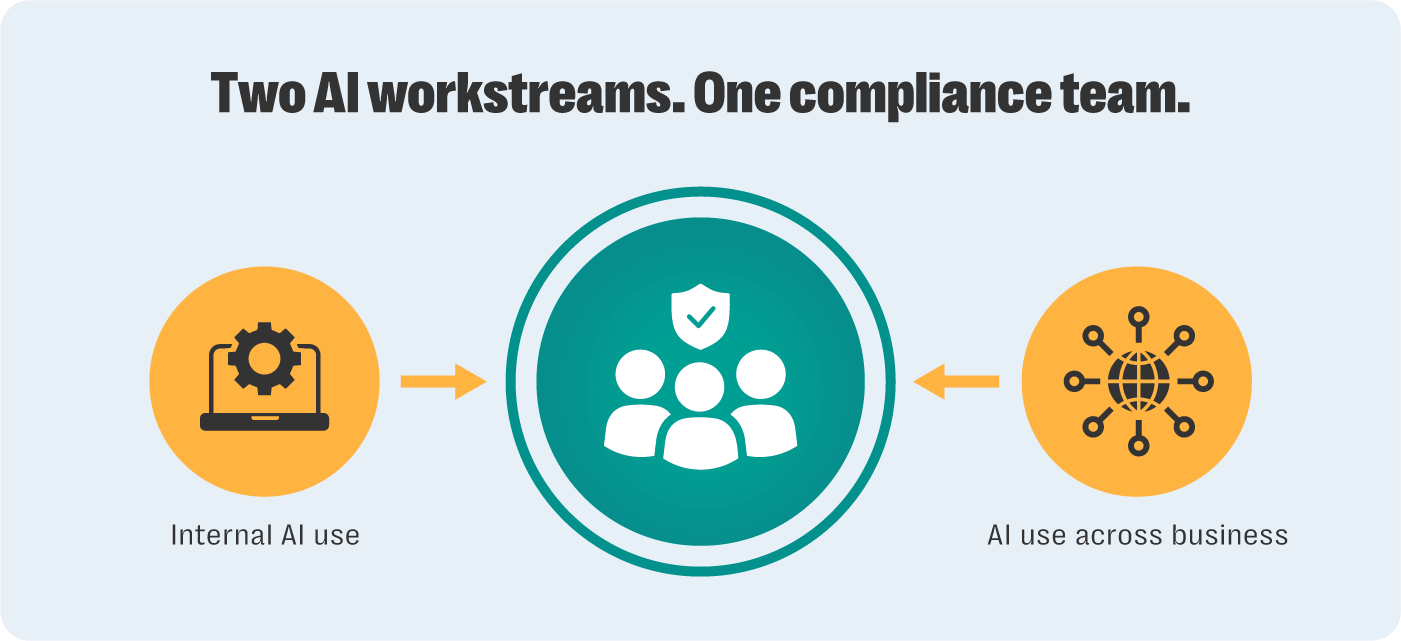
AI is hitting compliance from two directions at once. For GRC leaders, this creates a dual mandate:
- Enable safe AI adoption internally
- Enforce consistent governance across the business
Most programs were not designed to do both at scale.
First, compliance teams are being asked to use AI tools in their own work. That conversation has been happening for years. Early adoption was slow, and the hesitation was understandable: hallucination risk, unreliable outputs, and limited confidence in automated decisions. Most teams landed in what Bradley describes as the “AI assistance phase”. AI speeds up the work, surfaces information faster, and drafts first passes. But a human still reviews and signs off before anything goes out the door.
That’s still the dominant model across most organizations. But momentum is building – and expectations are shifting.
Second, and this is newer: Compliance teams are now part of the approval chain for AI being deployed elsewhere in the business. Finance wants to use a predictive model for credit decisioning. Operations are piloting an LLM to summarize regulatory updates. HR is testing an AI-assisted screening tool. Someone needs to review those use cases, assess the risks, and formally sign off before they go live.
That someone is increasingly compliance teams.
Approval portals, structured review workflows, and formal AI risk ratings are becoming standard asks. Compliance teams that built their programs around static rules and annual reviews are now being handed a governance mandate that requires something fundamentally different. It’s an ongoing, adaptive oversight of systems they didn’t build and may not fully understand. That gap between what compliance was designed to do and what it’s being asked to do is where most of the friction lives.
What leaders are missing
When considering the most overlooked considerations for scaling AI governance, two themes came up consistently:
- Assume adoption is already happening: A significant share of employees are using AI tools right now – sanctioned or not. Treating this as a containment problem is a losing strategy. The organizations seeing the most traction with AI governance aren’t the most restrictive ones. They’re the ones where leadership defined what’s acceptable early, built curated use cases the business could trust, and made it easy to follow guardrails rather than work around them.
- Data sovereignty isn’t an IT problem: When AI tools interact with customer data, process personally identifiable information PII, or operate across multiple jurisdictions, the question of where data lives, who can access it, and how decisions get explained to regulators becomes a compliance issue, fast. Many firms in regulated industries are already encountering friction over exactly this. Organizations that mapped their data flows before AI tools were embedded into operations are finding remediation manageable. The ones who waited are dealing with a much harder problem.
Getting these two things right doesn’t guarantee a mature AI-ready regulatory compliance program. But getting them wrong almost certainly derails one.
There’s a third gap that some don’t consider: operating model clarity. Many organizations have not defined who owns AI risk, who validates models, and who is accountable when outcomes change. Without clear ownership, governance breaks down quickly.
 |
How AI Is Being Used in GRC: 5 Practical Patterns for Risk & Compliance TeamsGet a practical look at how AI fits into real GRC workflows with the five patterns reshaping how risk and compliance teams manage regulatory change, reporting, and operational complexity. |
Building an effective AI regulatory compliance program
An AI regulatory compliance program reflects a shift in maturity, from static control frameworks to continuous, risk-based oversight embedded across the AI lifecycle. A modern program isn’t measured by the number of policies it produces. It’s measured by how well governance is embedded into the AI lifecycle – at design, at deployment, and at every update in between.
From a technical standpoint, that means three things:
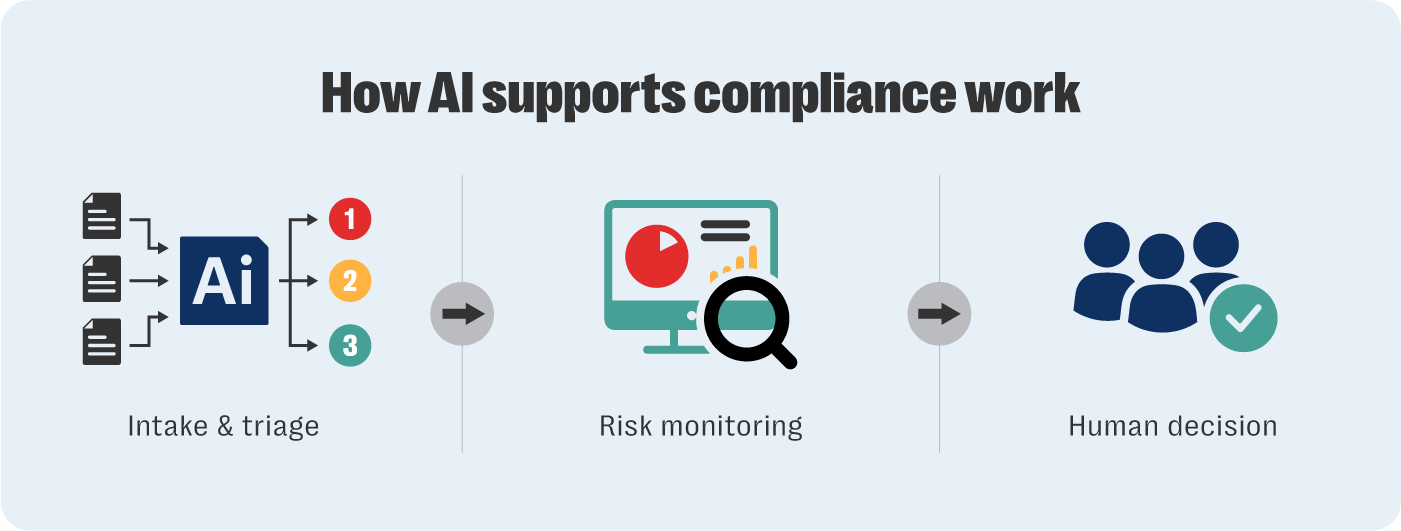
- Scale: AI tools let leaner compliance teams do significantly more. Classification models can triage incoming regulatory events, flagging what needs immediate attention. Clustering models can group similar control requirements to reduce duplication. Early predictive models are beginning to surface risk and control insights before they become audit findings. The teams getting the most out of these tools aren’t replacing analysts – they’re freeing them from the work that doesn’t require human judgment, so they can focus on the work that does. This reduces operational friction and allows teams to focus on risk analysis instead of repetitive tasks.
- Control: Continuous monitoring matters more than point-in-time assessments. A red-amber-green risk rating framework applied to AI models gives compliance teams a live view of where risk is concentrated, and what needs immediate attention. Bradley noted that this tiered approach is critical: Not every AI model carries the same risk, and governance effort should be proportional to that risk. A low-risk classification model used internally is not the same compliance challenge as a customer-impacting decisioning tool.
- Confidence: The end goal isn’t to automate compliance decisions. It’s to give compliance professionals better information, so the decisions they make are more defensible. AI as a capability multiplier, not a replacement for expertise.
The goal is not to replace expertise. It’s to support faster, more defensible decisions with better data and visibility.
When AI makes the decision itself
Alongside the technical layer, an AI-ready compliance program needs a governance structure that’s built for how automation really works. That means defined ownership for AI controls, and clear escalation paths when a model’s behavior changes. It also means accountability structures that don’t dissolve when a system updates itself or moves into a new deployment context.
That last point matters more as AI becomes more autonomous. Most organizations are currently governing AI that assists by surfacing recommendations, flagging anomalies, and drafting outputs. A human still makes the call. But agentic AI is different. These are systems that don’t wait for instruction. They assess a situation, decide on a course of action, and execute it – sometimes across multiple steps and systems – without a human in the loop at each stage.
For compliance, that changes the question entirely. It’s no longer just “did a human make a defensible decision with AI input?” It’s “how do we document, explain, and audit a decision that no human explicitly made?” What triggers oversight, what gets logged, how decisions can be reconstructed after the fact need to be built into the system’s design. Not added later, when something goes wrong. Regulators are increasingly focused on explainability, traceability, and accountability in AI-driven decisions. Without these, compliance risk increases significantly.
The approval portal is the new policy
One of the clearest signals of where compliance is heading is the rise of the formal AI approval workflow.
Teams are building structured processes to review AI use case requests coming in from across the business. Each request gets assessed against a defined risk framework. Higher-risk models – those touching customer data, making consequential decisions, or operating in heavily regulated contexts – require more rigorous documentation, more stakeholder sign-off, and more frequent review cycles. Lower-risk, internally-facing tools move through faster.
This is compliance functioning as a governance layer, not just a checkpoint. It’s a structural shift in what the function is responsible for, and it changes how compliance leaders need to position themselves internally. The teams doing this well aren’t just saying yes or no to AI requests. They’re building the infrastructure that lets the business move fast on AI without accumulating governance debt it’ll have to pay back later. That’s what AI-ready regulatory compliance looks like in practice. Not more policies. Smarter oversight, built into the workflow from the start.
This shift also requires structured workflows, centralized tracking, and consistent risk scoring across all AI use cases.
 |
AI Features in Compliance Software: What GRC Teams Should Look For to be Policy-ReadyLearn how to spot the AI features that support real review, approval tracking, and audit-ready records GRC teams can stand behind. |
Go from framework to function with Resolver
AI is already shaping how compliance work gets done. The real question is how teams support it without losing control.
Oversight gets harder as models, approvals, and expectations grow. At the same time, decisions need context, changes need tracking, and every output needs to stand up when someone asks how it was produced.
Resolver’s GRC platform gives teams a place to manage that work end to end. Risk, obligations, controls, and approvals stay connected, so AI in compliance fits into existing workflows instead of creating new gaps. Teams can track how decisions are made, keep oversight consistent, and respond with confidence when regulators ask questions.
Watch the on-demand session to see how teams are approaching AI-driven compliance in practice, or book a demo today to see how Resolver’s AI-powered regulatory compliance program works.