

The report lands. Then what?
Your organization commissioned an ethics and compliance assessment. Consultants interviewed stakeholders, reviewed documentation, and benchmarked your program against peer organizations. The report arrived with findings, gaps, and a clear picture of where the program fell short. What it didn’t include was a path to execution.
This is more common than most compliance leaders want to admit. Assessments are treated as finish lines rather than starting points. The work goes in, the report comes out, and meaningful change quietly stalls. In this blog, we’ll explain why that happens — and what it actually takes to move from findings to action.
Why ethics and compliance assessments are commissioned
Most assessments are triggered by a regulatory requirement, a leadership mandate, or a significant incident. Others follow a company merger or a broader effort to benchmark and strengthen program maturity. In each case, the organization needs external validation — proof the program meets a credible standard.
That external perspective matters. Peer benchmarking only adds value when the comparison group reflects your regulatory exposure, organizational scale, investigation volume, and industry sector. Without that alignment, findings lack relevance and are harder to operationalize.
Credible ethics and compliance assessments account for this. They define the peer group carefully, weigh findings against your program’s actual maturity, and distinguish between aspirational best practices and realistic next steps.
But even the most credible assessment can stall. The problem usually isn’t the quality of the findings. It’s what happens after.
How results lose momentum
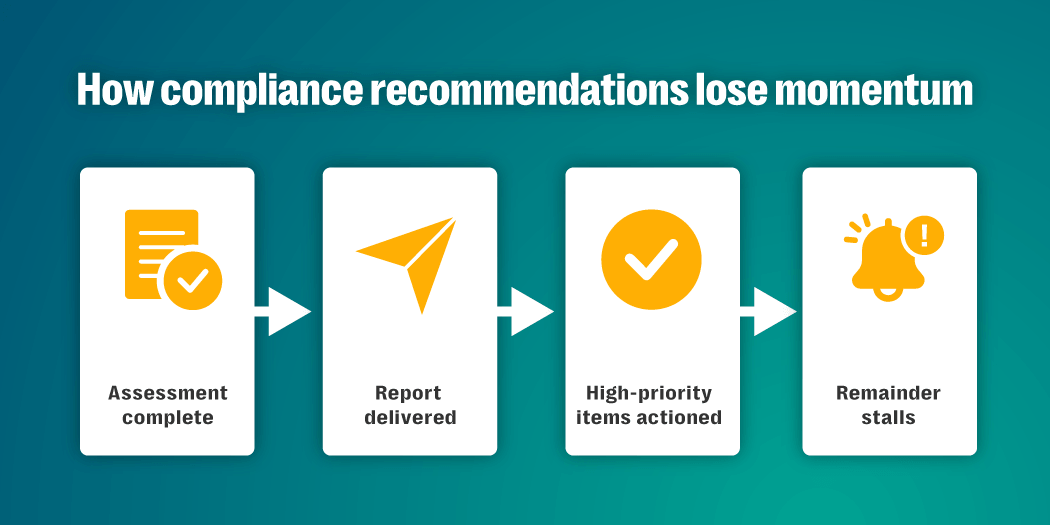
Here’s a pattern that repeats itself across compliance programs: An assessment wraps up, leadership reviews the summary, the report gets filed — maybe shared with the board, maybe presented to the broader team. A few high-visibility recommendations get actioned quickly because they’re tied to a regulatory deadline or easy to execute.
The rest don’t make it far.
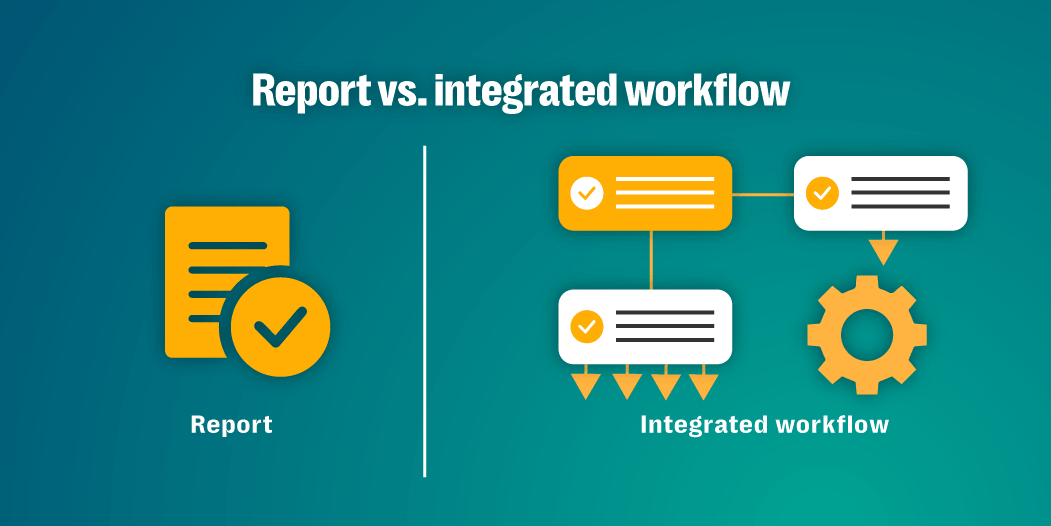
Competing priorities and leadership turnover play a role. But the deeper issue is structural. Recommendations land outside the systems that govern day-to-day program execution — separate from workflows, ownership structures, and reporting visibility. That makes them easy to deprioritize, even when the intent to act is genuine.
Two other factors compound this. First, most programs don’t re-rank findings against actual risk exposure after the report is issued. Without that prioritization step, teams have no clear basis for deciding what to act on first.
Second, many recommendations are written at a high level. Translating “improve third-party oversight” into specific, assigned actions takes time and judgment. And without a defined process for that translation, execution stalls before it starts.
The result is a gap that widens quietly. By the time someone asks about the assessment, the recommendations haven’t moved.
The gap between findings and ownership
Assessments generate findings, yet they rarely assign operational ownership inside the workflows that govern the program.
A recommendation like “strengthen third-party due diligence processes” is meaningful. Without a named owner, a defined scope, and a deadline, it’s just an observation. It competes with every other priority on someone’s plate — and it usually loses.
Most ethics and compliance assessment frameworks are built to produce a report. They’re not built to assign accountability or integrate findings into day-to-day program management.
The assessment team finishes its work and moves on, then the compliance team receives the report and is expected to drive implementation. That often happens without dedicated resources or a mechanism to track progress against the original findings.
Because those findings aren’t embedded into the compliance program’s operating rhythm, they fade. By the time the next assessment cycle arrives, the organization is often relitigating the same gaps.
 |
What Ethics and Compliance Benchmarking Really Tells YouEthics and compliance benchmarking shows where your program ranks — but not why. Learn how to move beyond peer comparison and use benchmark data as a judgment tool, not proof of effectiveness. |
Why reports alone don’t drive change
A report captures a moment in time. It reflects the state of your program at the point of assessment, not what the program looks like six months later when regulatory requirements shift or a new business line gets added.
After an ethics and compliance assessment, findings must be ranked against actual risk exposure. A named leader must have both ownership and authority to act. Remediation milestones must be visible to executive oversight. Progress must link back to the original gap so the board can see movement over time.
When compliance teams lack the infrastructure to operationalize findings, even a well-resourced assessment produces limited return.
Rethink ethics and compliance assessments with Resolver
Programs that embed assessment findings into their operating systems show measurable improvement between review cycles.
This means integrating assessment outputs into the same environment where the compliance program runs day to day. When findings live in a separate document — disconnected from case management, policy workflows, and reporting — they’re easy to deprioritize. When they’re embedded in the platform your team uses to manage investigations, track obligations, and report to the board, they stay in view.
Resolver’s Whistleblowing and Case Management platform connects assessment findings to the workflows that run your program. Our program assessment and benchmarking are powered by ECI’s globally recognized framework. That gives you clear visibility into program maturity and peer comparisons across speak-up culture, case outcomes, and overall program performance — directly within Resolver, alongside your live case data.
When regulatory requirements shift or your program matures, you can adjust priorities without starting over. Speak with our team to see how Resolver connects assessment insights to program action.
