



This is a decisive year for online safety. From the EU’s Digital Services Act (DSA) and the UK’s Online Safety Act (OSA) entering full enforcement, to new child protection duties in Brazil and age assurance deadlines in Singapore, regulations are now being embedded across the globe. The penalties for noncompliance are significant, including substantial fines and, in some jurisdictions, personal criminal liability for senior executives. Taken together, this global legislative momentum signals a permanent shift: online safety regulation is here to stay.
This moment presents a critical choice for platforms: continue to treat compliance as a reactive, accelerating cost, or adopt a proactive, unified approach that positions Trust and Safety (T&S) as a strategic capability that minimizes risk, drives efficiency, and builds genuine user trust. At a time when trust in major online platforms is declining — particularly among younger users — how technology companies respond to this new regulatory era will have a defining impact on their credibility, resilience, and long-term market position.
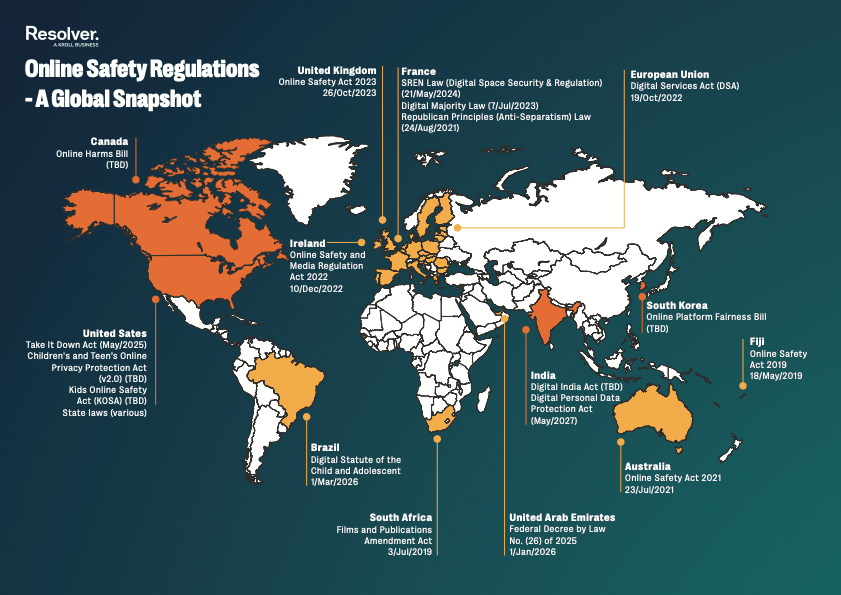
Online safety regulations are now in force or proposed across more than 40 countries worldwide.
“Repairing” vs. “Preparing”: The reactive trap
Continuing to build bespoke, just-in-time, jurisdiction-by-jurisdiction responses to emerging regulations is a resource drain. It risks:
 |
Escalating, unpredictable costs: As additional duties are introduced, compliance expands as a disjointed cost center, diverting capacity to short‑term fixes with little ability to plan or demonstrate return on investment. |
 |
Undermining user trust: When safety measures are implemented unevenly across markets or products, platforms struggle to demonstrate consistency. This fragmentation undermines user trust and creates internal friction while also weakening a platform’s ability to show regulators that risks are being addressed in a coherent, systematic way. |
 |
Increased regulatory exposure: Timelines for implementing changes are dictated by regulators. As authorities shift from engagement to enforcement, mistakes become costly. |
This cycle of reactivity creates mounting operational and regulatory drag that is becoming untenable. To break it, platforms need a model that treats compliance as a design constraint rather than an after-the-fact patch.
The strategic path: Compliance as a design constraint
A proactive strategy starts with moving away from bespoke, regulation‑by‑regulation fixes. Instead, it involves setting a global baseline of common safety standards that can flex to specific market requirements, while embedding Safety by Design into policy, product, and operations. This approach doesn’t weaken user safety — it gives T&S teams the clarity and structure they need to work with a more effective mandate.
Four focus areas to make Trust and Safety a strategic capability
For executives seeking to position their business for sustainable growth, Trust & Safety isn’t about one-off fixes or isolated tools. It’s about how your systems work together to spot risk and provide accountability. For both leaders and teams on the ground, success comes down to getting four core areas right:
1. Assess your service risk: Know your exposure to prioritize investment
Regulation is making comprehensive risk assessments mandatory. When approached in the right spirit — as a strategic activity, not a box-ticking exercise — this foundational step yields significant returns.
- For Executives: A clear, evidence‑based picture of harm exposure enables better prioritization of product updates and governance changes. This leads to a clearer view of the return on investment of your T&S approach, enabling you to shift resources to where they mitigate the greatest regulatory risk.
- For T&S Professionals: Risk assessments offer a data-driven path to establishing clearer mandates. They provide the evidence needed to advocate for product and policy changes that genuinely address the highest-prevalence harms, ensuring T&S measures are ambitious and high-impact.
2. Know your users: Enable informed, nuanced choices
The public debate around child safety and age‑appropriate experiences continues to gain momentum, making clarity on your user base a prerequisite for navigating regulatory developments.
- For executives: Platforms that truly understand who is using their service can avoid the need for blunt, defensive interventions that impact all users, such as age-gating or one‑size‑fits‑all controls. Informed, nuanced choices allow for appropriately adapted experiences, minimizing friction for the general user base while applying higher standards of protection and privacy where they are most needed (e.g., for children).
- For T&S professionals: Understanding user demographics, particularly age, is key to moving beyond “hygiene factors” and baseline controls. This knowledge enables T&S teams to design effective, targeted safeguards, ensuring the focus remains on robust, context-specific user safety.
3. Unify controls and outcomes: Compliance as the golden thread
Most platforms and technology service providers already have numerous T&S measures in place. The challenge is often the lack of a clear line of sight between existing controls, identified risks, and strategic outcomes.
- For executives: Aligning existing initiatives within a unified compliance framework brings scattered interventions into a cohesive, defensible strategy. This reduces silos, eliminates overlapping or contradictory measures, and ensures the work already invested in safety contributes directly to regulatory compliance. This is a massive efficiency driver that protects institutional knowledge.
- For T&S professionals: A unified framework validates and leverages existing expertise, by clearly showing how day‑to‑day Trust & Safety work helps mitigate risk and keep users safe. It provides the basis for a coherent strategy that can be shared confidently with regulators, allowing T&S staff to acquire the necessary regulatory knowledge and focus on continuous improvement.
4. Engage actively with regulators: Shape future standards
Online safety regimes are still maturing, with regulators actively testing assumptions and refining guidance. Engagement now is not a liability — it is a strategic opportunity.
- For executives and T&S professionals: By sharing high-quality evidence — on the prevalence of harm, the effectiveness of safety measures, and the practical trade-offs involved — platforms and online service providers can proactively shape how rules are interpreted and enforced. Not engaging risks navigating frameworks that have been designed without your operational reality in mind. Constructive dialogue helps ensure the rules that survive are practical, implementable, and capable of delivering meaningful safety outcomes.
By embracing regulation as a design constraint that strengthens Trust & Safety, platforms gain a competitive advantage through a more predictable, repeatable approach to compliance — reducing regulatory surprises, lowering risk, and protecting existing investment
For executives, this approach makes compliance more predictable and defensible, helping avoid exponential costs and severe penalties while protecting prior investment in Trust & Safety programs and deepening user trust — a clear path to sustainable growth. For T&S professionals, it results in clearer mandates, the ability to align work to strategic outcomes, and the recognition of T&S as the strategic capability it needs to be, ensuring the focus on user safety is efficient, effective, and fully supported by the business.
Resolver and Illuminate Tech: An end-to-end compliance solution
Resolver and Illuminate Tech work together to support platforms navigating complex, multijurisdictional online safety obligations. For over 20 years, Resolver has provided risk discovery and harm identification, while Illuminate Tech supports aggregation, scoring, and reporting across regulatory requirements. Together, this approach helps organizations move from fragmented compliance efforts to more consistent, evidence‑based safety governance within a single workflow.
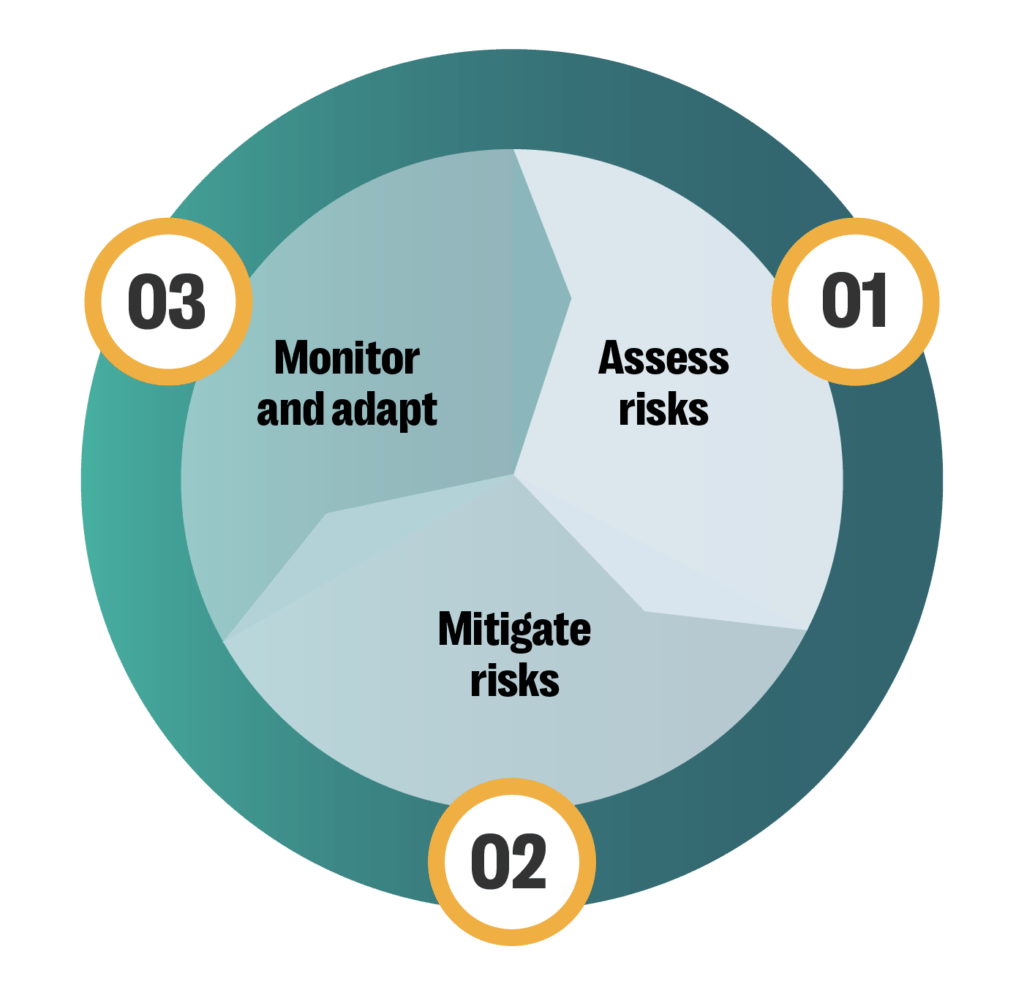
The strategic insight derived from this process is twofold: it provides executives with the necessary data to accurately demonstrate the Return on Investment (ROI) in their T&S operations — and to protect that investment over time — while shifting compliance from a cost center to a predictable and effective business function. Simultaneously, it empowers T&S professionals with a clear, evidence-based mandate, ensuring their focus remains on the most effective and high-impact measures for user safety.
The era of online safety regulation is here. The strategic choice is to address this challenge with purpose, efficiency, and a renewed commitment to user trust. If your organization is assessing how to respond to the new regulatory era, we’d be glad to share our perspective.